
Last updated November 21, 2026
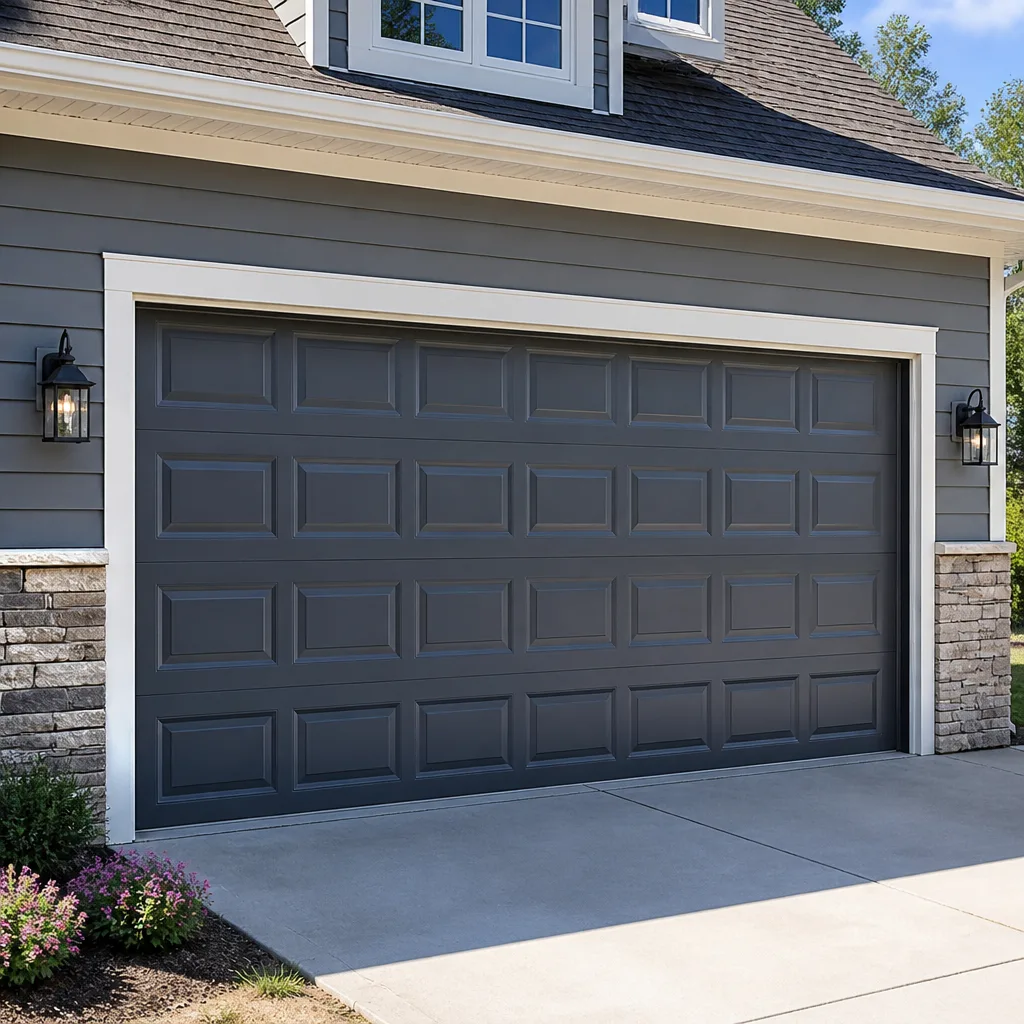 Raised-panel steel
 Carriage house
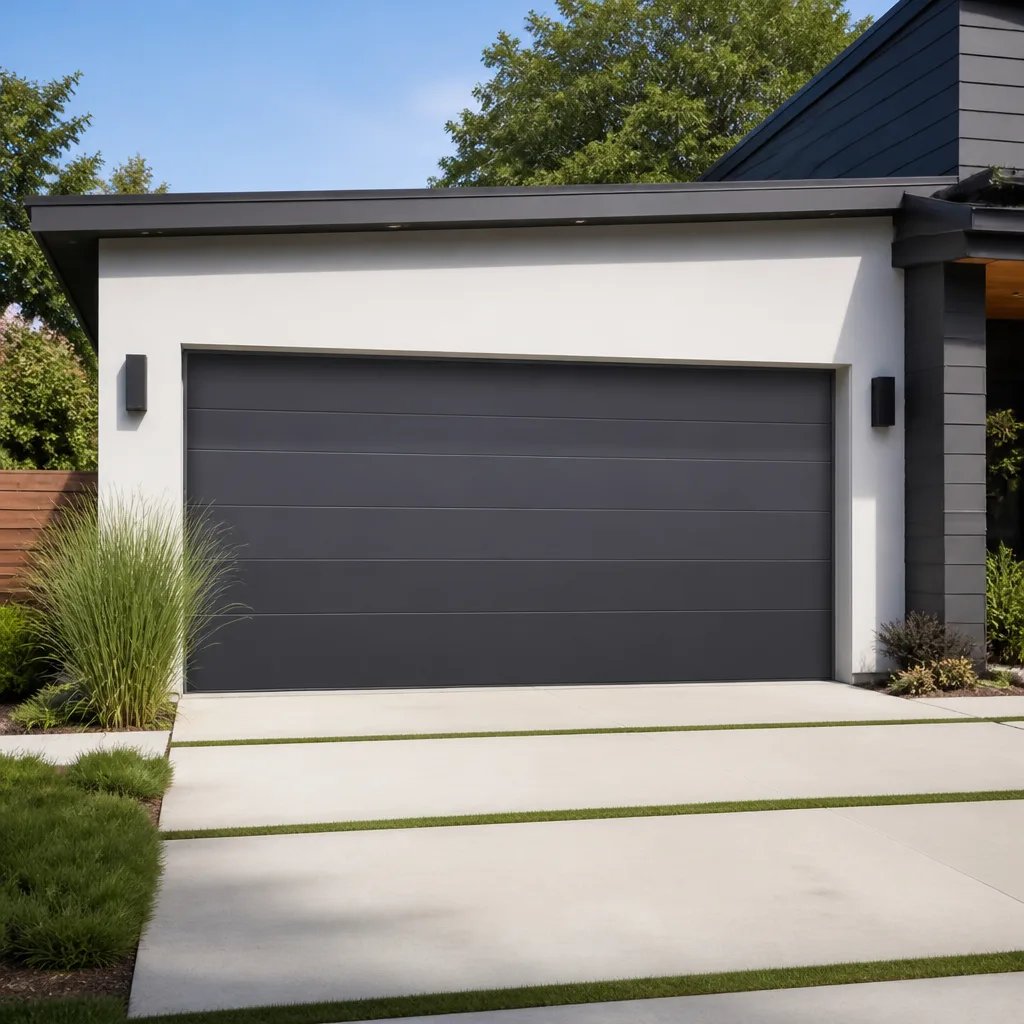 Modern flush
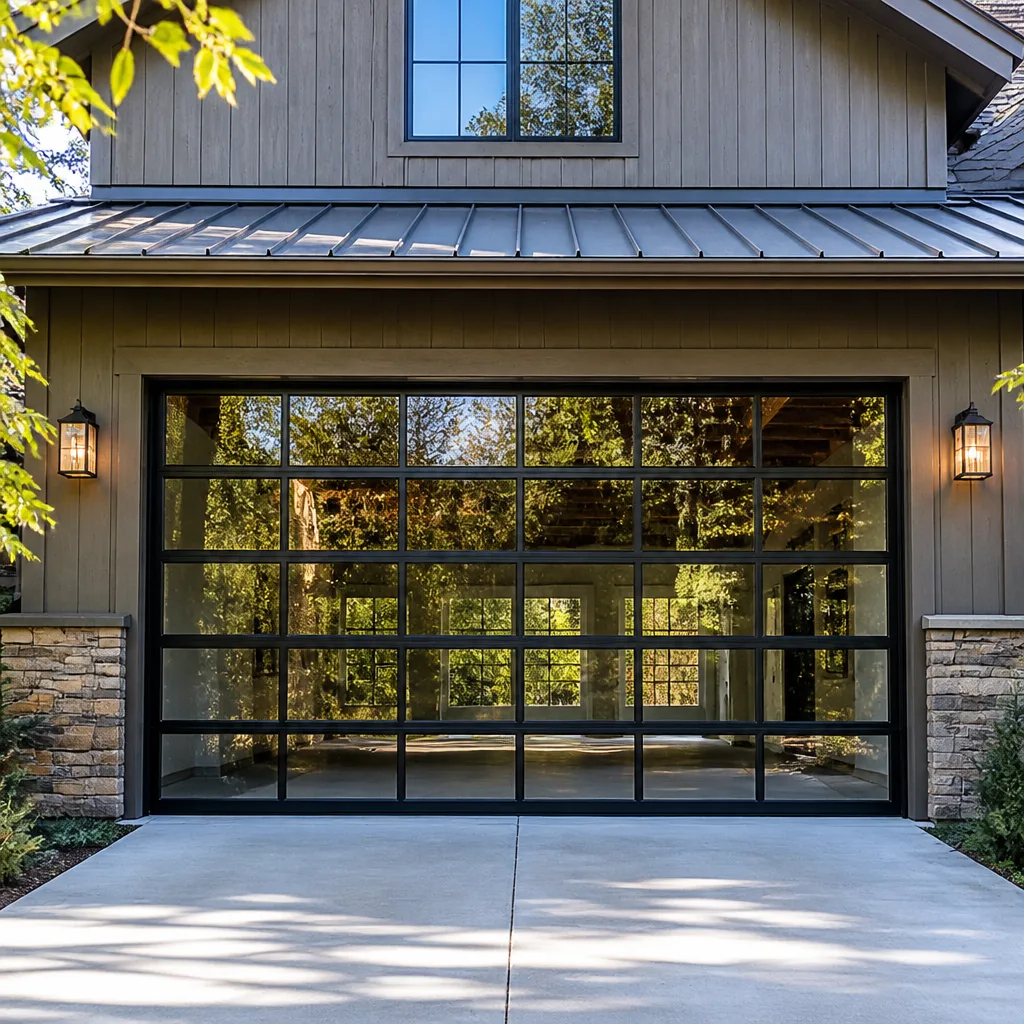 Full-view glass
 LiftMaster openers
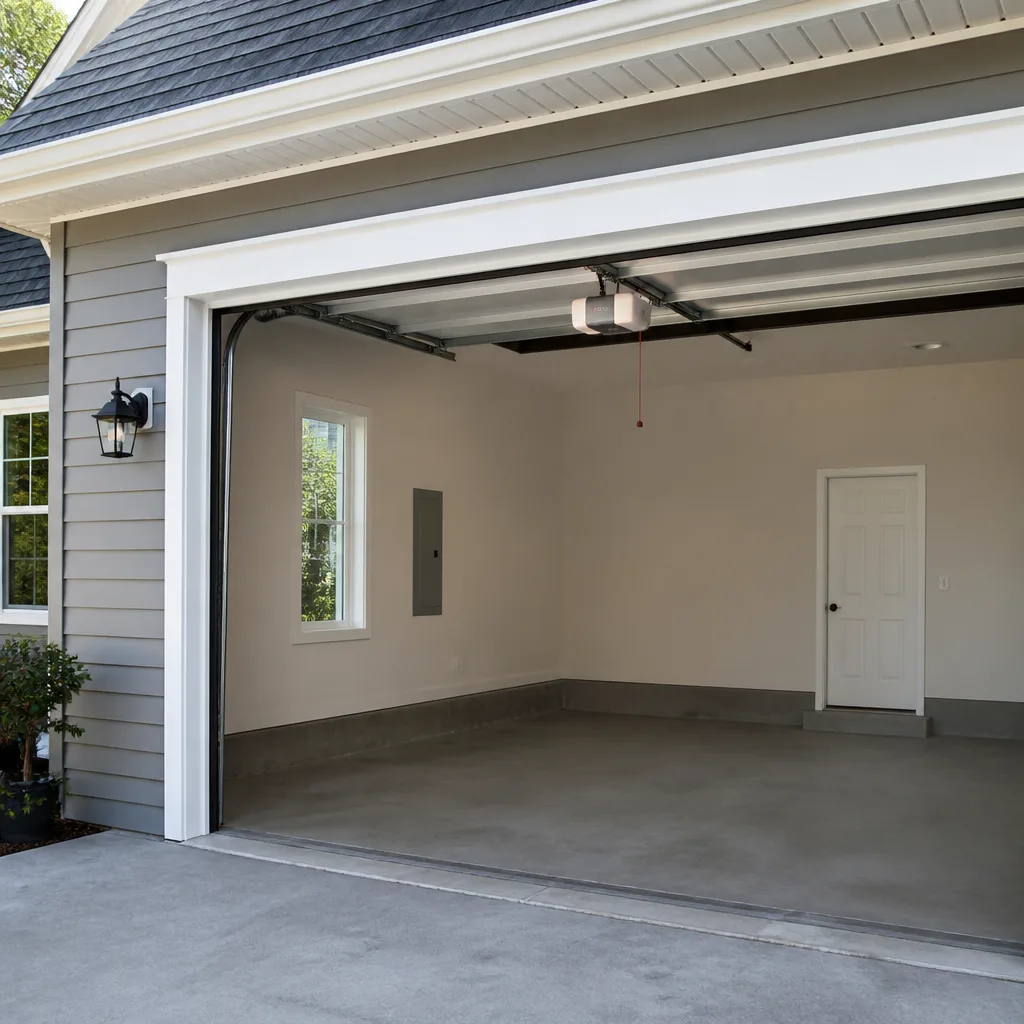 Chamberlain openers
Full 25-point door and opener safety check with every visit - springs, cables, rollers, tracks, and your LiftMaster or Chamberlain opener included
You get a price before we start. It does not change when the pro arrives.
Get your free estimateHow to Hire a Garage Door Contractor in Poinciana: A Step-by-Step Guide
If a garage door company can give you a firm quote over the phone without asking what brand your opener is, that’s not efficiency. That’s a sign they’re pricing a service call, not your actual repair. Garage doors are not interchangeable. A LiftMaster logic board, a Chamberlain belt drive, a Craftsman chain unit and a Raynor torsion system all fail differently, and the technician standing in your garage needs to recognize which one is in front of them. In Poinciana, that distinction matters more than most homeowners realize, because a large share of the “local” names that surface in search results are regional dispatch operations that route your call to whoever is free that day. This guide walks you through screening a contractor properly, from the first phone call to the signed estimate, so you know exactly who is working on your door and why.
Quick Answer
Hiring a garage door contractor in Poinciana comes down to four checks: confirm the company will tell you whether it subcontracts the work or sends its own technicians, verify the contractor’s license through Florida’s DBPR portal before you book, ask which brands the technician is trained on and whether they carry the parts for yours, and insist on a written estimate that itemizes parts, labor and the specific work being done before anyone touches the door. If a company can’t or won’t answer those four questions, keep calling.
Styles & brands we work with
- Raised-panel steel
- Carriage house
- Modern flush
- Full-view glass
- LiftMaster openers
- Chamberlain openers
Table of Contents
- Why Most “Local” Garage Door Companies in Poinciana Aren’t Local
- The One Screening Question That Saves You the Most Trouble
- How to Verify a Florida Garage Door Contractor in Under Two Minutes
- Brand Familiarity: What It Actually Means for Your Repair
- What a Legitimate Written Estimate Must Include
- Red Flags Specific to the Poinciana Market
- Why Poinciana’s Climate and Housing Shape Garage Door Wear
- The Questions to Ask Before You Book
Why Most “Local” Garage Door Companies in Poinciana Aren’t Local
Search for a garage door contractor in Poinciana and you’ll get a page of results that look local. Many of them aren’t. A meaningful number are lead-generation sites or regional dispatch services that buy advertising across a wide area, take your call from a call center, and then hand the job to whichever subcontractor is available in your zone. The address on the website may be a suite number, a virtual office, or nothing at all. What that means for you is simple: the person who shows up at your house may have never worked on your brand of door, may not carry the part your opener needs, and may be meeting your garage for the first time with no diagnostic history behind them.
This isn’t a knock on every regional company. Some run tight operations with well-trained technicians. But the dispatch model introduces a variable you can’t see from the outside, and that variable is who actually does the work. In Poinciana, where the housing stock ranges from newer builds in communities like Bellalago and Solivita to older homes off Cypress Parkway and Pleasant Hill Road, the doors in use vary widely in age and brand. A technician who works this area regularly learns the local mix. A technician dispatched from two counties away is starting from zero every time. We mention this because it’s the single biggest difference between a repair that holds and one that comes back.
What separates a genuinely local operation from a dispatch service is not the website design or the review count. It’s whether the company can tell you, before you book, who will be at your door and what brand training that person has. That’s a question you should ask directly. Start with the Poinciana Garage Door Repair Co approach as a benchmark: the technician who diagnoses your door is the technician who repairs it, with no handoff mid-job.
The One Screening Question That Saves You the Most Trouble
Ask every company you call one question before anything else: “Do you subcontract your work?” The answer tells you more than an hour of conversation. Here’s what to listen for:
- “No, our technicians do the work.” That’s the answer you want. It means the person arriving at your home is trained, vetted and accountable to the company you hired, and that the company stands behind the repair from diagnosis through completion.
- “We work with a network of local pros.” That’s a subcontracting model. It doesn’t automatically mean bad work, but it means the company you called is a coordinator, not a technician, and the quality of your repair depends on which pro happens to be assigned.
- “We’ll send someone out and see.” That’s a dispatch service. The company doesn’t know who’s coming any more than you do. Walk away.
- A long pause, then a deflection. Also a dispatch service. If the answer isn’t immediate and clear, it isn’t yes.
Why does this matter so much for garage doors specifically? Because garage door repair – and spring work above all – is the highest-risk task in the home-service trades. A torsion spring under tension stores enough energy to cause serious injury if it’s handled wrong. A technician who has only done a handful of spring replacements under supervision is not the same as one who has done hundreds. When a company subcontracts, it has no control over that distinction, and neither do you. A company that performs the work in-house has a direct reason to train its technicians properly and to keep the ones who know what they’re doing.
This is also why we push back on the “one-stop shop” framing you’ll see in a lot of marketing. Full-scope capability matters – springs, openers, panels, full door installation under one roof – but only if the same company does all of it. A company that subcontracts the spring work to one pro and the opener work to another is simply a middleman with three phone numbers. Ask the question. The answer is worth the thirty seconds.
How to Verify a Florida Garage Door Contractor in Under Two Minutes
Florida requires contractors to hold a state license for the work they perform, and the state makes it easy to check. Before you book any garage door company in Poinciana, spend two minutes on the Florida Department of Business and Professional Regulation (DBPR) license lookup. You’ll find it by searching “DBPR license lookup” in any browser. Here’s the process:
- Get the license number from the company. Ask for it directly on the phone. A legitimate contractor gives it without hesitation. If the company says “we’re licensed and insured” but won’t produce a number, that’s the answer.
- Search the DBPR portal. Enter the license number or the company name. The portal returns the license type, status (current, expired, suspended, or revoked), and the qualifying individual behind the license.
- Confirm the license type matches the work. Garage door installation and repair typically falls under a specialty or general contractor classification, depending on scope. If you’re having a full door replaced, ask the company to confirm their license covers installation, not just service.
- Confirm insurance separately. The DBPR portal shows license status, not insurance coverage. Ask the company for a certificate of insurance showing general liability, and call the insurer if you want to verify it’s current. This is standard practice and a legitimate company expects the question.
What you’re looking for is a current, active license tied to a real qualifying individual. What you’re avoiding is an unlicensed operator who can’t be held accountable if something goes wrong, and an expired license that means the contractor isn’t operating legally in Florida. Neither is common, but both exist, and the check takes less time than making coffee. For any contractor you’re considering, ask for the license number and verify it. Then ask whether the technician arriving at your door is covered by the company’s insurance. If either answer is evasive, move on.
One more note: license verification doesn’t tell you whether the technician is good. It tells you the company is legitimate. You still need to screen for capability, which is the next section.
Brand Familiarity: What It Actually Means for Your Repair
“We service all brands” is on nearly every garage door website. It’s also close to meaningless on its own. Every company will say it. The question is what it means in practice. A technician who genuinely knows your brand can look at your opener and tell you in a few minutes whether the problem is the logic board, the travel limits, the safety sensors, or the drive gear. A technician who doesn’t will start swapping parts and hope one of them fixes it, which is how a $200 repair becomes a $500 one.
Here’s what brand familiarity looks like in practice on the brands you’re most likely to have in a Poinciana home:
- LiftMaster and Chamberlain. These two share a great deal of internal architecture, so a technician trained on one is generally fluent in the other. Common failure points include the logic board after a power surge and the drive gear on older chain units.
- Craftsman. Very common on older homes, and often running well past its expected service life. Parts availability matters here – some older Craftsman models are easier to repair than replace, and some aren’t.
- Raynor. Often paired with heavier commercial-grade hardware. Spring systems on Raynor doors tend to be robust but require proper matching when they’re replaced.
- Genie, Clopay, Amarr, Wayne Dalton. Each has its own quirks in opener electronics, door panel construction, and spring sizing. A technician who works across all of them knows what to expect.
A company that works across all eight major brands – LiftMaster, Chamberlain, Genie, Clopay, Amarr, Wayne Dalton, Craftsman, and Raynor – is in a better position to diagnose your door on the first visit, because the technician isn’t learning your brand on your time. That’s the practical reason brand coverage matters. The less obvious reason: a brand-agnostic company has no incentive to steer you toward one manufacturer’s parts over another. Recommendations come from what fits your door and your budget, not which brand pays a referral margin. When you ask “do you service my brand,” listen for specifics. A technician who can tell you the common failure mode on your model is the one you want. Compare that with the garage door repair approach we take: brand-specific diagnosis before any part is ordered.
What a Legitimate Written Estimate Must Include
A written estimate is your protection against the invoice that shows up at the end with numbers you didn’t agree to. In Florida, a legitimate garage door estimate should include several specific items. Here’s what to look for before you sign anything:
- The specific diagnosis. Not “repair garage door” – but “replace torsion spring, left side” or “replace opener logic board.” If the estimate is generic, the invoice will be too.
- Parts, itemized by name and brand. If a spring is being replaced, the estimate should say what size and cycle rating. If an opener part is being replaced, it should name the part. This matters because a “$200 spring repair” can mean very different things depending on what spring is going in.
- Labor, stated separately. Some companies quote a flat price for parts and labor combined. That’s fine, but it should be stated clearly, not buried.
- The matched-pair note. If both springs are being replaced together, the estimate should say so. A matched pair costs about twice the price of a single spring, and you should see that reflected in writing before work starts.
- Any additional work that may be needed, flagged in advance. If the technician sees cable wear during diagnosis, that should be on the estimate as a “may be needed” line, not a surprise line on the invoice.
- The final price, explicitly stated as the price. The estimate is not “starting at” and it’s not a ballpark. It’s the number the company will hold to, unless you approve something additional in writing.
What an estimate that creates a dispute looks like: a verbal quote, a hand-written note with a single figure, a “we’ll figure it out when we’re in there,” or a quote that’s suspiciously low before the technician arrives and suspiciously high after. In our experience, most invoice disputes in this trade trace back to a verbal quote that was never converted to writing. Insist on the written version. Ask the technician to walk you through it before any work starts. If something is unclear, ask. The written estimate sets the final price, and a legitimate company expects you to read it carefully.
Spring pricing deserves a specific note here because it’s the most common source of confusion. A spring replacement is priced per spring. A single torsion spring replacement typically runs $180 to $340 in the Poinciana market. A matched pair, which is what most technicians recommend replacing together because both springs have aged and both will fail, costs about twice that. If you’re quoted one figure for both springs, ask which it covers. If the estimate doesn’t distinguish, ask. There is no such thing as a single-spring price that covers a pair.
Red Flags Specific to the Poinciana Market
Poinciana sits at the meeting point of three counties, which means the contractor market here has some quirks you won’t see in tighter metro areas. Here are the red flags we’d tell a friend to watch for:
- Out-of-area trucks with no explanation. A technician arriving in a truck from an unfamiliar county is not automatically a problem, but it’s worth asking who they work for and whether they subcontract. A local operation can tell you exactly which technician is coming and where the truck is coming from.
- No physical address. A company with no verifiable business address is a dispatch operation. Ask for one and check it. A legitimate contractor has a real address, whether it’s a business office or a registration tied to the qualifying individual.
- Quotes that don’t mention parts sourcing. If the estimate doesn’t say what parts go in, ask. Generic “spring replacement” quotes are an invitation to use whatever’s on the truck, which may not match your door’s needs. Spring size and cycle rating matter for durability.
- “We can be there in the next thirty minutes” as the first thing they say. Fast response is fine – it’s a real part of what we do – but a company leading with response time before asking you what’s wrong is pricing a service call, not your repair.
- A firm price before they know your brand. This is the one from the top of this guide. A firm quote without a brand check is a service-call price, not a repair price. The price for a LiftMaster logic board and a Genie logic board is not the same.
- No written estimate. In Florida, the written estimate is the standard for this work. A company that resists putting the price in writing is telling you something about how the invoice conversation will go.
- “Licensed and insured” with no license number. Anyone can say it. Ask for the number and verify it on the DBPR portal. Thirty seconds.
What these red flags share is a lack of accountability. A dispatch service that shows up, quotes per call, and doesn’t put the price in writing has no direct stake in whether the repair holds. A local operation that performs the work in-house does. That’s the difference to screen for. For emergency situations where the door is stuck or won’t close, response time does matter, and fast dispatch matters more. But speed and accountability aren’t opposites. A company that does both is the company you want. Our garage door opener repair work is a good example – the same company that diagnoses the opener is the one that replaces the electronics.
Why Poinciana’s Climate and Housing Shape Garage Door Wear
Poinciana’s climate is mild in winter and hot and humid in summer, and that pattern affects garage doors in specific ways. Heat causes springs to expand and contract with the day-night temperature swing, and while that’s not dramatic on a mild day, the cumulative effect over years is real. Humidity accelerates wear on steel and on the lubricants that keep hinges and rollers moving smoothly. A door that squeaks in July may run quiet by November, but the wear that caused the squeak doesn’t reset.
Beyond climate, the housing mix matters. Poinciana has a lot of homes built over the past few decades with standard 7-foot and 8-foot single-car and double-car doors. Many of those doors are now on their second spring at least, and some are nearing the end of a spring’s expected life. As you talk to contractors, ask how they size a replacement spring. A technician who measures the door’s weight and existing spring dimensions is doing it right. A technician who grabs a spring off the truck and installs it is doing it faster, not better.
Humidity also affects opener electronics. Logic boards are prone to failure after power surges, which are more common in older neighborhoods during the summer storm season. If your opener has failed and you’re not sure whether it’s the board or the transformer, a technician with brand training on your specific model can usually tell on the first visit. That’s the value of brand familiarity in practice – fewer visits, faster diagnosis, and the right part on the first order.
The Questions to Ask Before You Book
Here’s the short list to run through on the phone, before anyone schedules a visit. A contractor who can answer these clearly is a contractor you can trust to be in your garage:
- Do you subcontract your work? The answer should be an immediate, clear no – and the technician arriving at your door should be someone the company can name and vouch for.
- What’s your license number, and is it current? Verify on the DBPR portal before you book.
- Which brands are your technicians trained on? Listen for specifics on your brand.
- Will the same technician who diagnoses also do the repair? Handoffs mid-job are a sign of a dispatch service.
- Will I get a written estimate before work starts, and does it set the final price? The answer should be yes, clearly.
- What’s the process if the diagnosis changes once you’re in the garage? A legitimate answer: the technician stops, explains what changed, and you approve additional work before it’s done.
- Do you have a physical business address? A real one, checkable.
- What’s your estimate policy? Estimates should be free and written.
Two of these deserve a specific note. On the diagnosis-change question: even with a good written estimate, sometimes a technician opens the housing and finds a secondary problem. The right move in that case is for the technician to stop, explain, and get your approval before proceeding. If the company doesn’t confirm that process, ask. On the address question: a company with a verifiable address and a current license is a company you can hold accountable. A fly-by-night operation with neither is not. For spring work specifically, this matters most, because the garage door spring repair task is the one where a shortcut can fail the door again a few weeks later. The technician’s training and the quality of the parts used determine whether the repair holds.
Common Mistakes to Avoid
- Booking based on the price quote alone. A price quote that’s lower than everyone else’s is worth asking about. The gap is often in the parts or in what’s not covered. Ask what the price includes before you book.
- Skipping the DBPR check because the website looks professional. A professional-looking website and a fake dispatch service aren’t opposites. The check takes thirty seconds and tells you what the website doesn’t.
- Assuming “we service all brands” is enough. It’s the starting point, not the answer. Ask which brand the technician arriving at your door has worked on recently.
- Accepting a verbal quote. Verbal quotes create the invoice disputes people complain about. Insist on the written version before any work starts.
- Assuming a single-spring price covers a pair. A matched pair costs about twice a single spring. If you’re quoted one figure for both, ask which it covers. Clear this up before the technician starts.
- Not asking about parts before the technician arrives. A “spring replacement” quote doesn’t say which spring. Ask what’s going in. Spring size and cycle rating determine how long the repair lasts.
- Letting the technician start work before you’ve read the estimate. Ask the technician to walk you through it. If you don’t understand a line, ask. The written estimate is the price. Protect it.
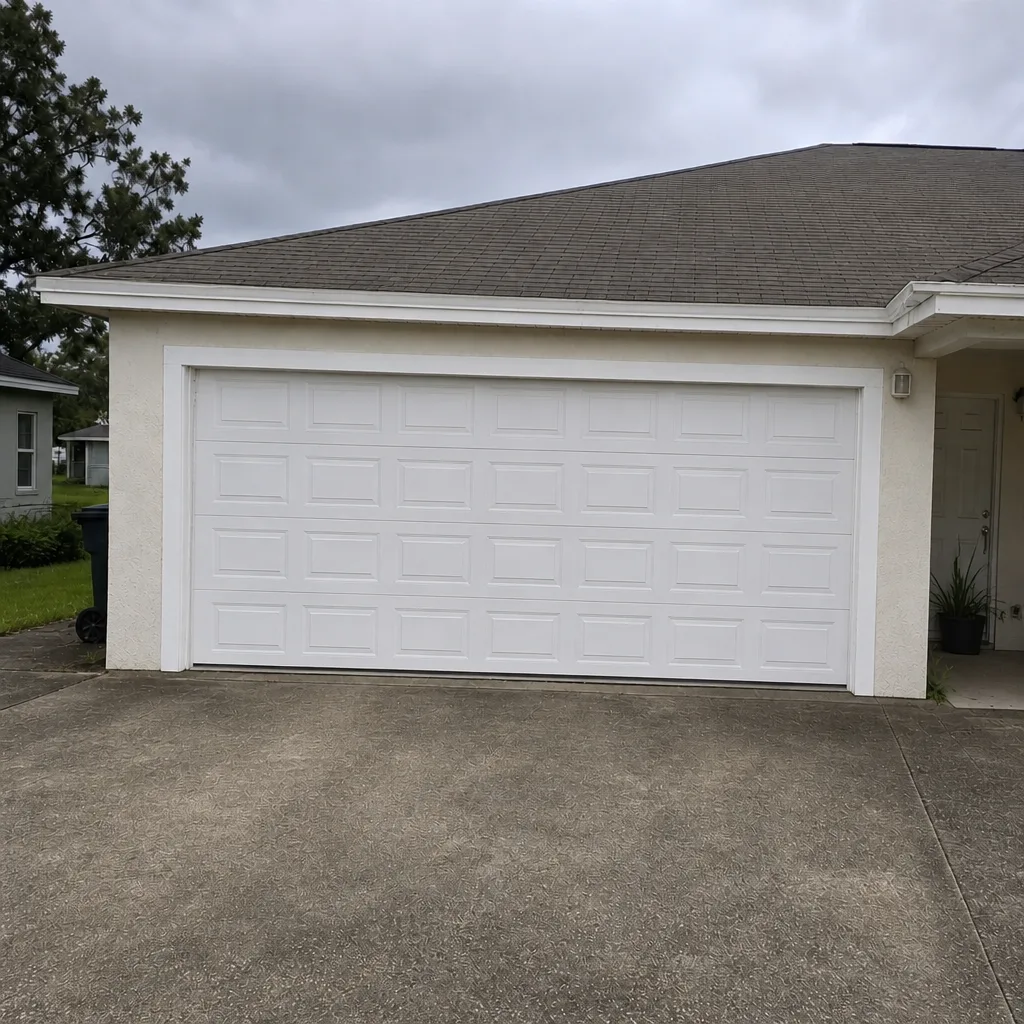
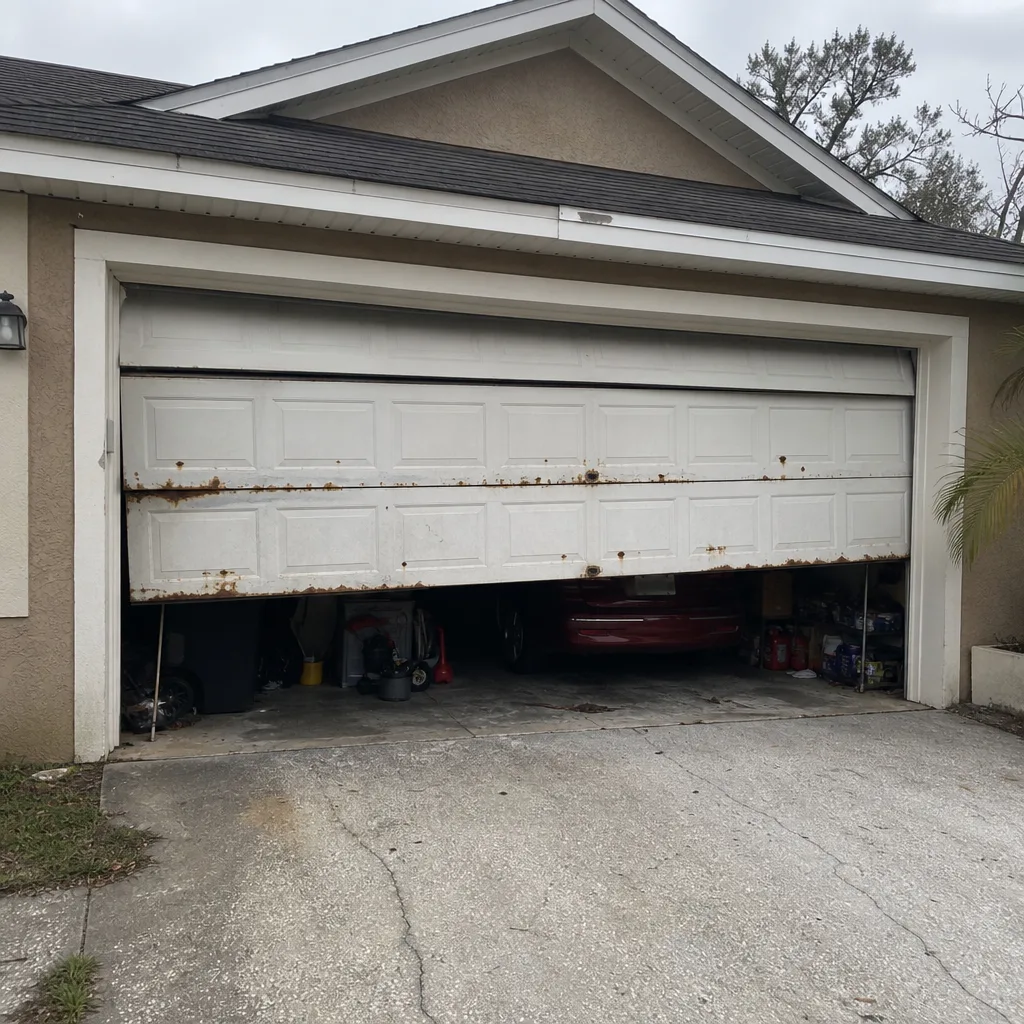
See the difference
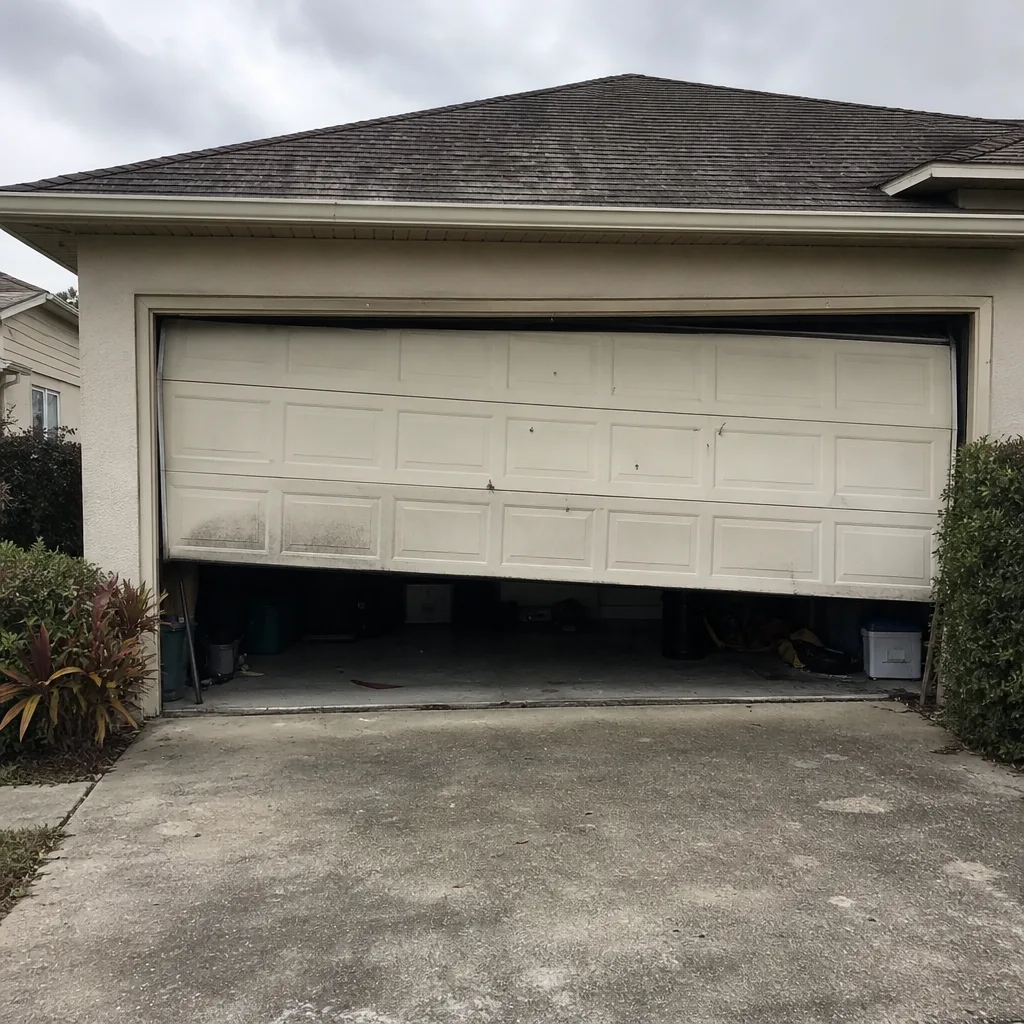 Before
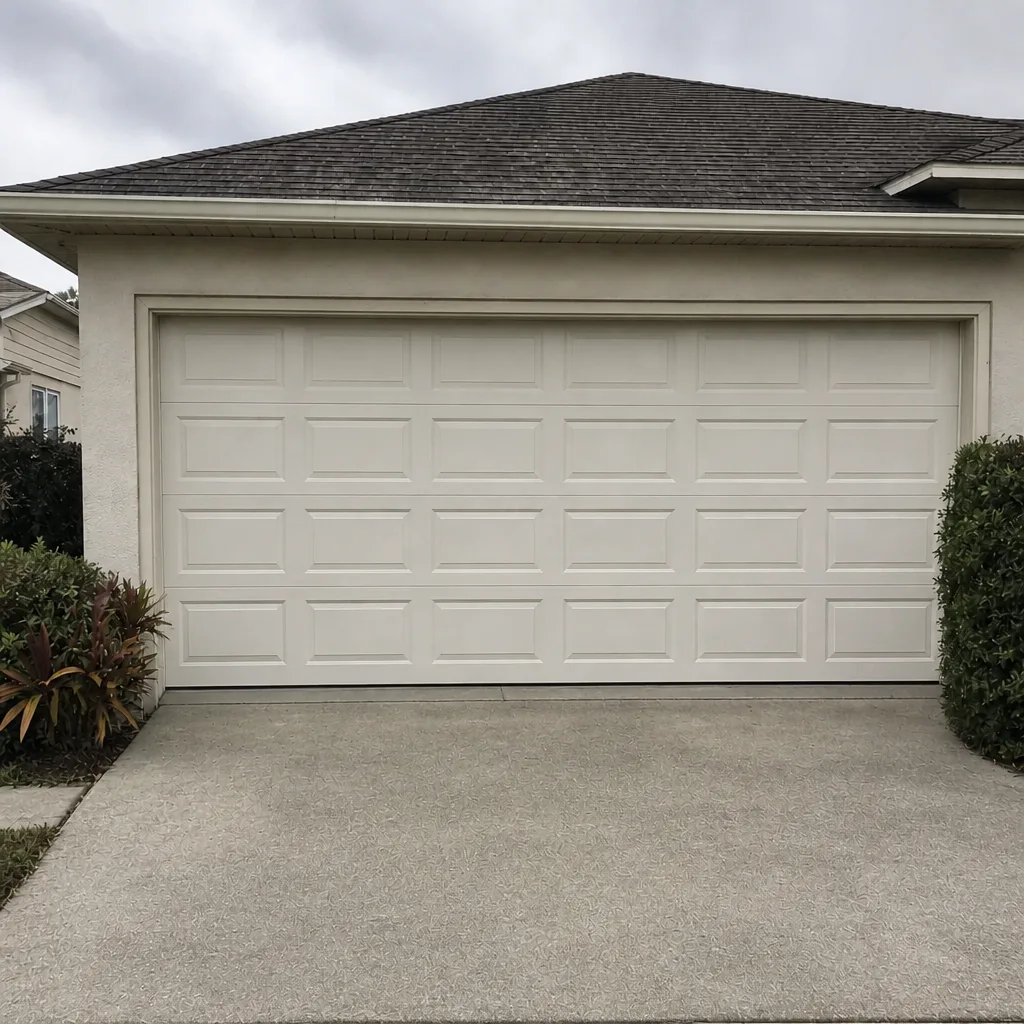 After
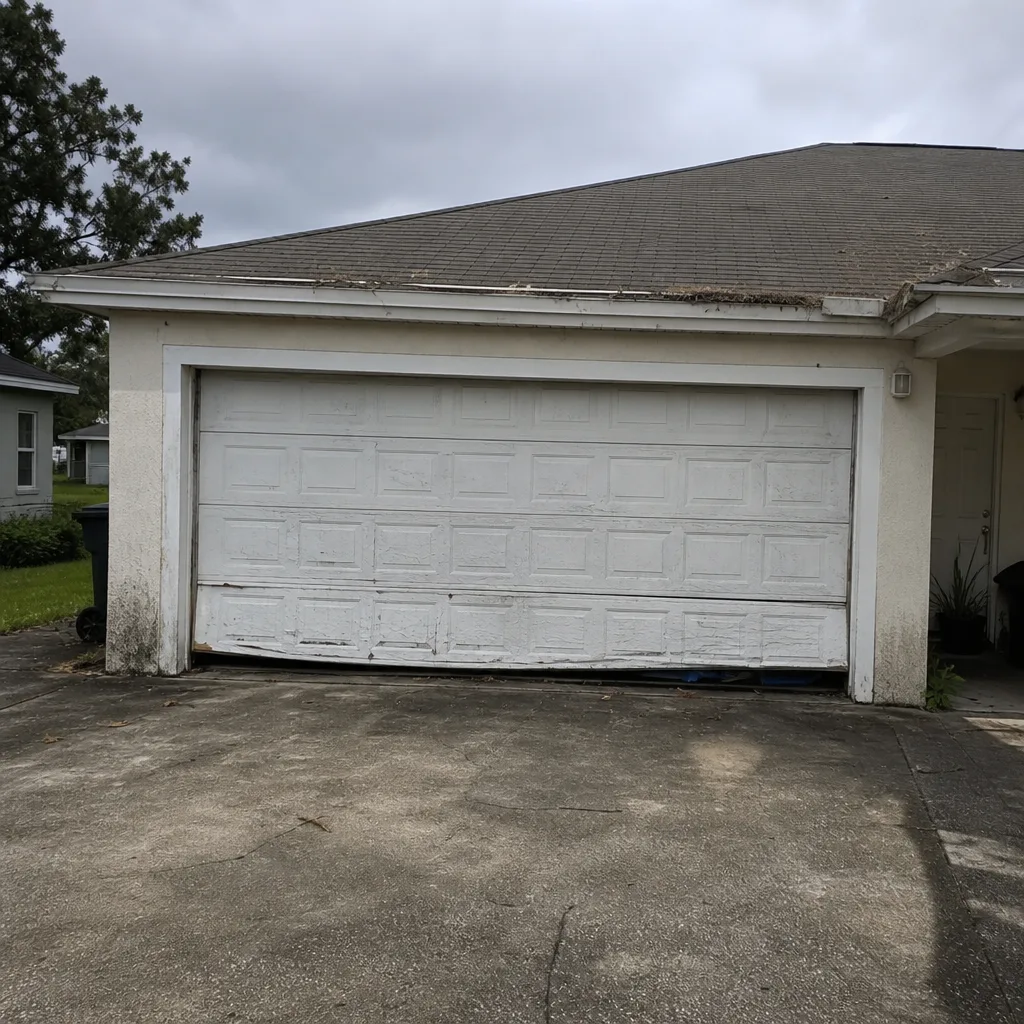 Before
 After
 Before
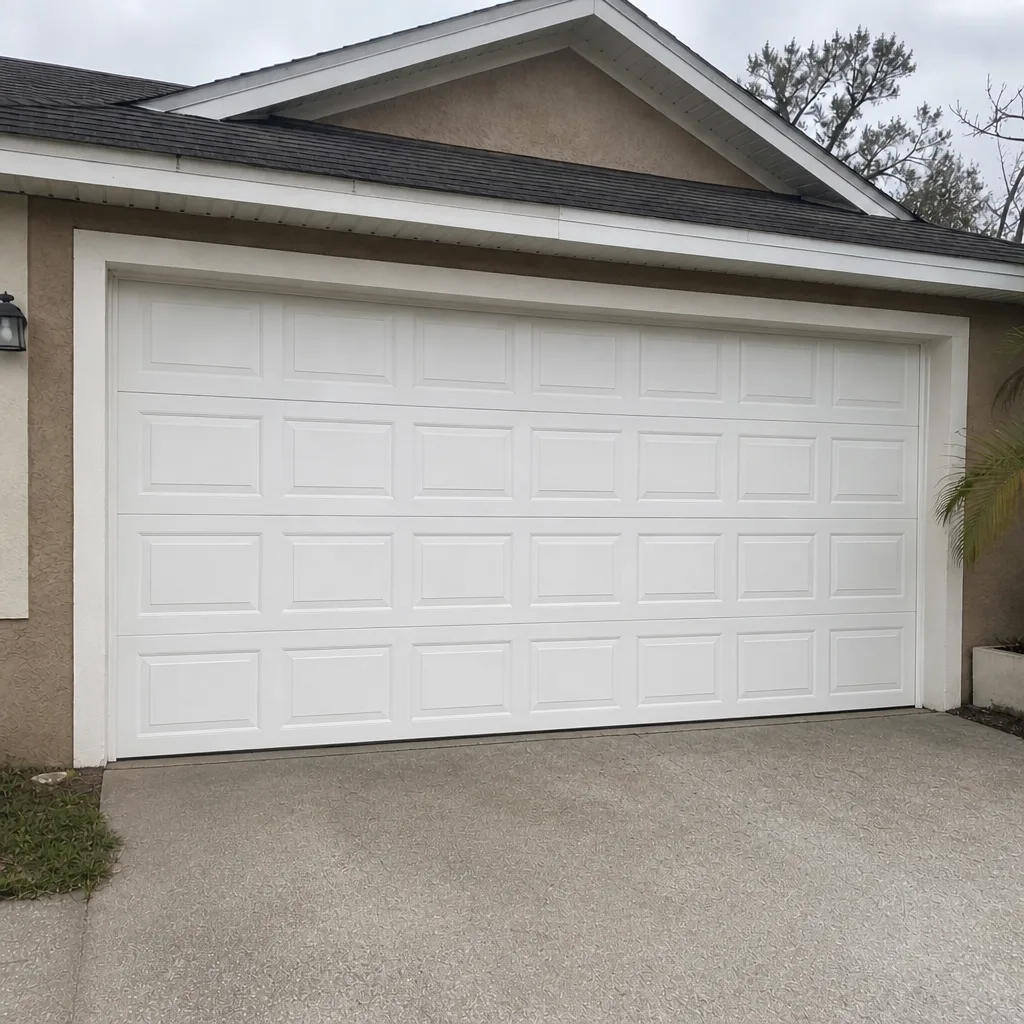 After
When to Call a Professional
Some garage door problems are genuinely dangerous to handle yourself. High-tension springs and the cables attached to them store enough energy to cause serious injury, and a garage door that’s fallen off a track or come loose from one of its hinges can drop without warning. Call a professional for any spring or cable issue, any door that’s fallen off track, any opener with a failed logic board or visible electrical fault, and any door that won’t close fully or won’t reverse when it hits an object. For springs in particular, don’t try to remove or loosen them yourself. The energy stored in a wound torsion spring is not something to be handled without training and the right tools. For smaller issues – a squeaking hinge, a remote that needs to be reprogrammed, a sensor that’s out of alignment – you can often resolve it yourself. When in doubt, call.
Poinciana Garage Door Repair Co offers free estimates in Poinciana. Call (877) 471-4560. We answer 24/7. Fast dispatch from 7am to 7pm, Sunday through Friday. Our technicians have up to 9 years of experience, we work on all eight major garage door and opener brands, and we perform the work in-house, with no subcontracting and no mid-job handoffs. If you’re not sure whether your issue needs a call, call anyway and ask. We’ll tell you what we think.
Frequently Asked Questions
Ask the company for its license number, then look it up on the Florida DBPR portal. The search takes under two minutes and shows the license type, status, and qualifying individual. A current license tied to a real person is what you want to see. If the company can’t or won’t produce a license number, that’s your answer. Call (877) 471-4560 for an exact quote – estimates are free.
A written estimate should itemize the specific diagnosis, the parts by name and brand, labor if it’s broken out separately, and the final price stated explicitly as the price. It should also note if a matched pair of springs is being replaced versus a single spring, since a pair costs about twice a single. If anything is unclear, ask the technician to walk you through it before work starts. Call (877) 471-4560 to schedule a free written estimate.
Some do, some don’t. The way to tell is to ask directly. A company that performs the work in-house can tell you immediately who’s coming and what brand training that technician has. A company that subcontracts will describe a “network of local pros” or won’t be able to name the technician. The single most useful screening question is “Do you subcontract?” Ask it first. Call (877) 471-4560 and we’ll answer it straight.
The written estimate sets the price. It shouldn’t change unless the technician finds a secondary issue during diagnosis, in which case a legitimate company stops, explains what changed, and gets your approval before doing additional work. If you’re quoted one price and invoiced another, ask why in writing. Call (877) 471-4560 for an upfront price before any work starts.
The independent local professional we connect you with is licensed and insured as Florida requires, and the license is verifiable through the DBPR portal. Ask for the license number before you book and confirm the technician arriving at your door is covered by the company’s insurance. Call (877) 471-4560 for details on licensing and insurance.
Often, yes. We answer 24/7, and fast dispatch runs from 7am to 7pm, Sunday through Friday. If your door is stuck open, won’t close, or has come off track, call (877) 471-4560 and we’ll book the next available slot. A call outside dispatch hours is booked into the next opening, Sunday through Friday, 7am to 7pm.
The Bottom Line
Hiring a garage door contractor in Poinciana properly comes down to four things: confirming the company doesn’t subcontract, verifying the license on Florida’s DBPR portal, asking which brands the technician is trained on, and insisting on a written estimate that names the parts and sets the final price. Those four checks separate a company you can hold accountable from a dispatch service that will hand your job to whoever is free. The climate here, hot and humid summers and mild winters, wears springs and opener electronics faster than you’d expect, which makes brand familiarity and parts quality more than marketing language. Free estimates, no subcontracting, all eight major brands. Call (877) 471-4560. We answer 24/7. Fast dispatch from 7am to 7pm, Sunday through Friday.
Written by the team at Poinciana Garage Door Repair Co.