
Last updated November 21, 2026
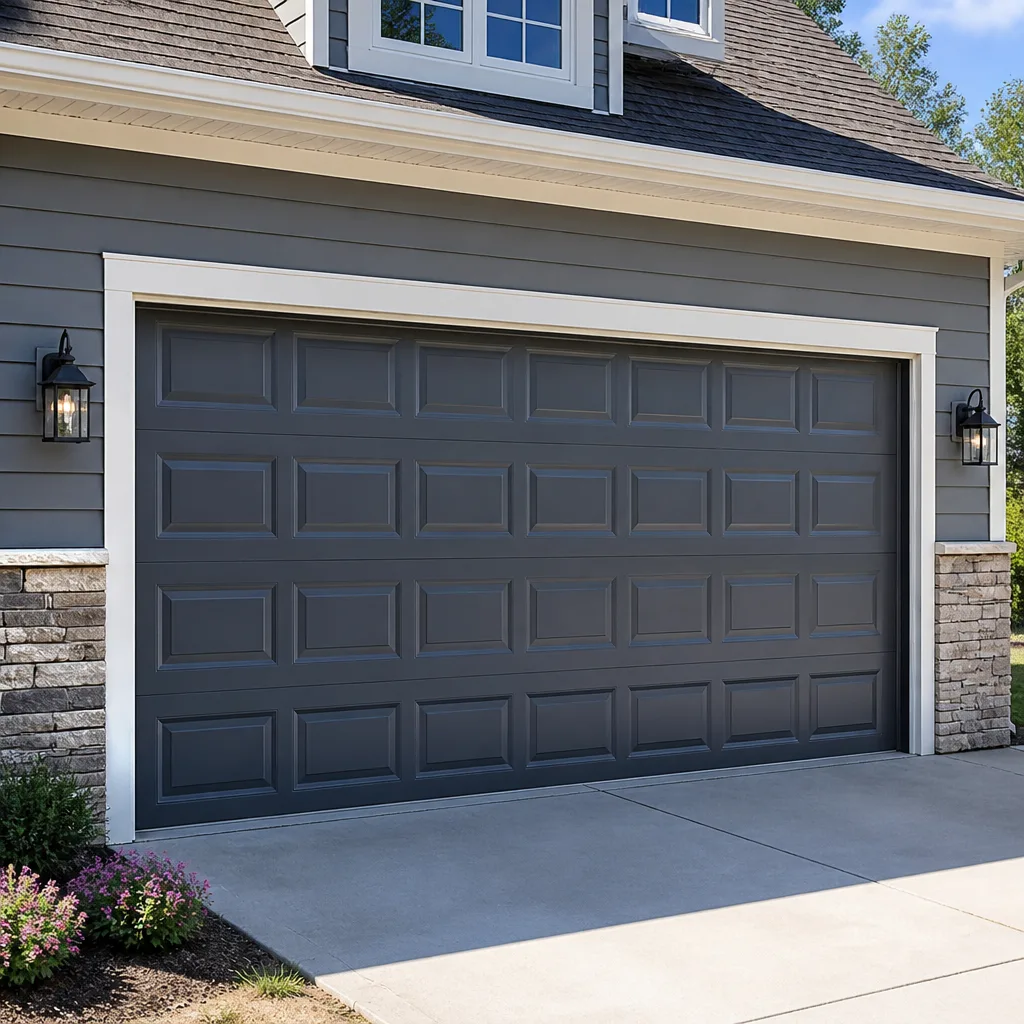 Raised-panel steel
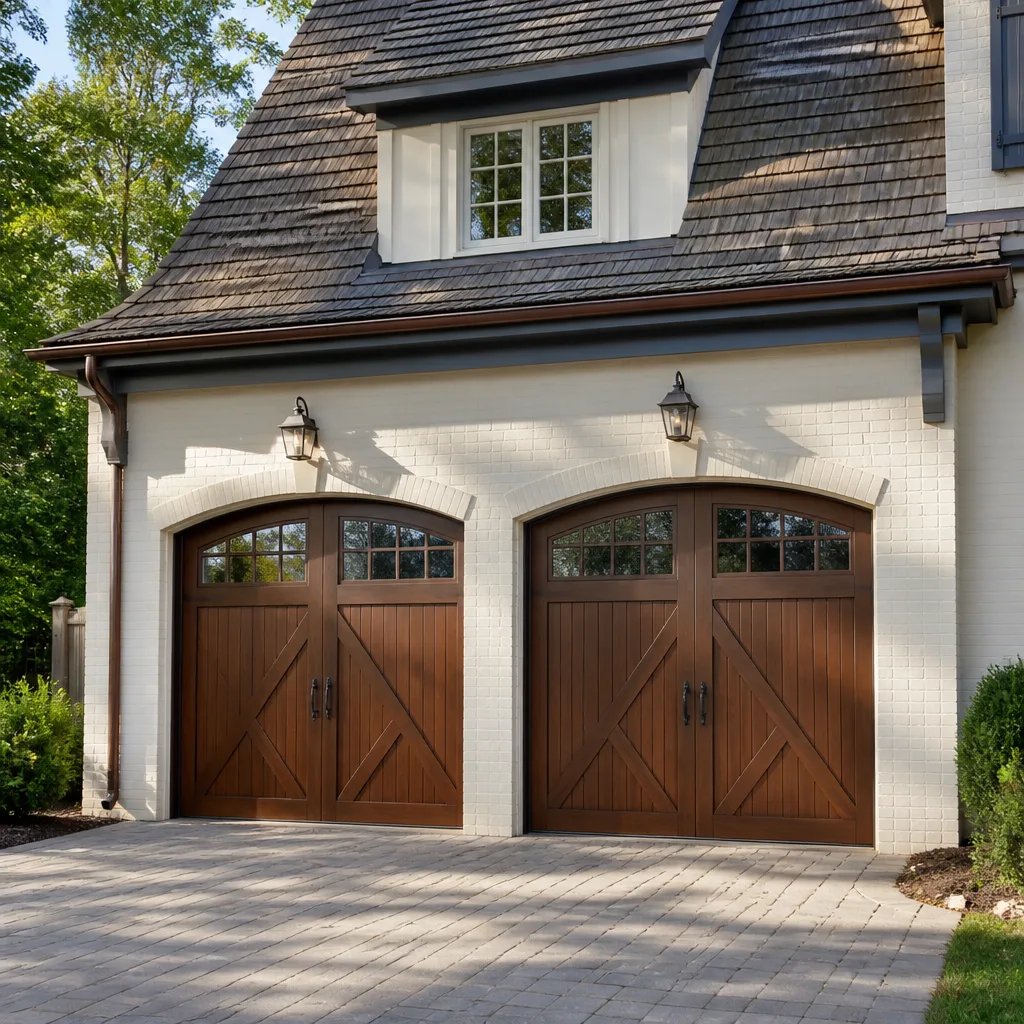 Carriage house
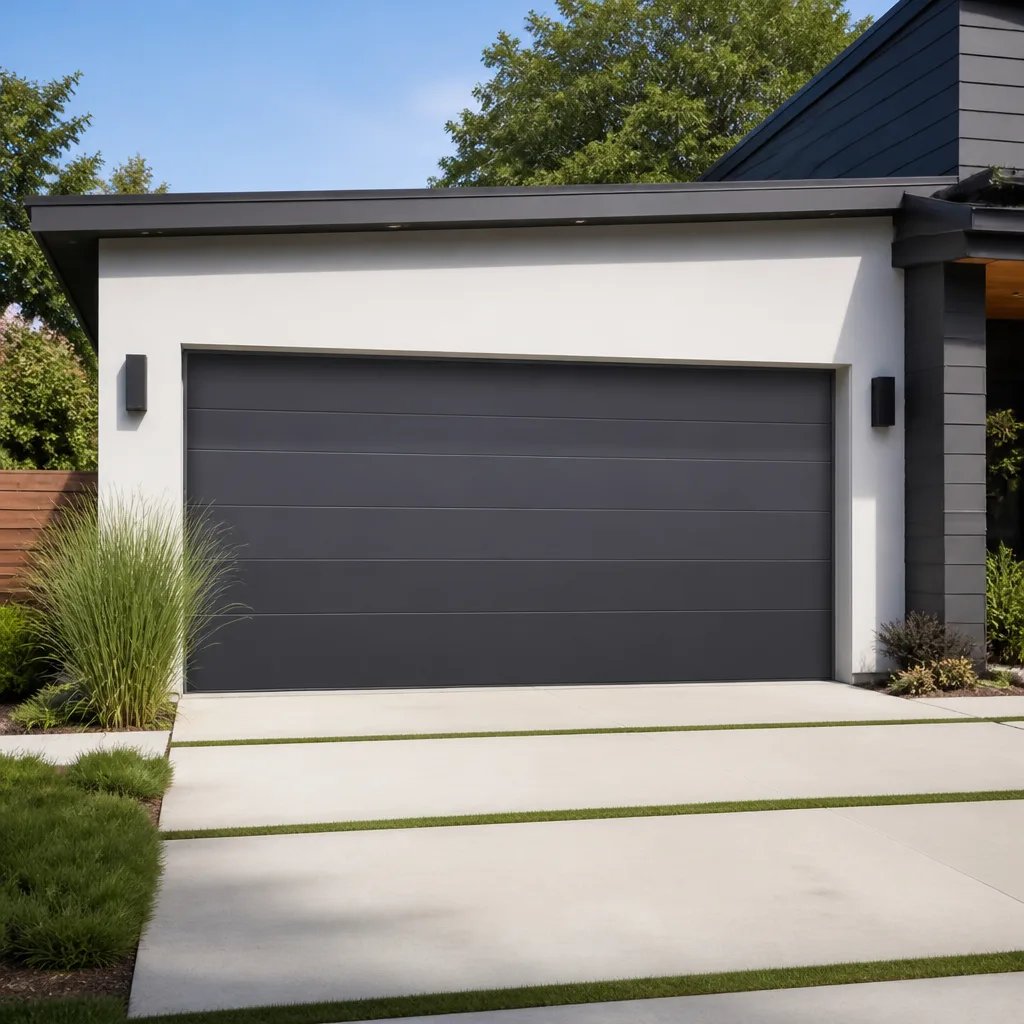 Modern flush
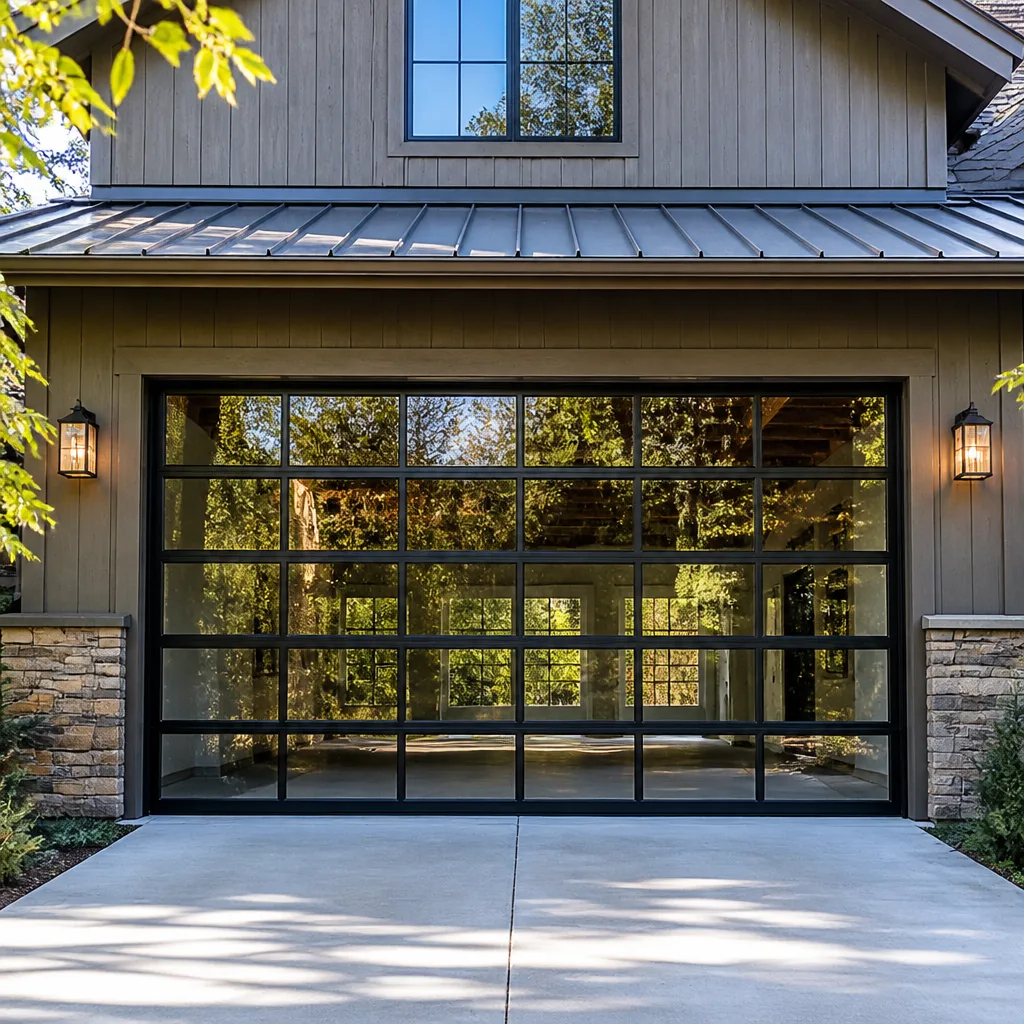 Full-view glass
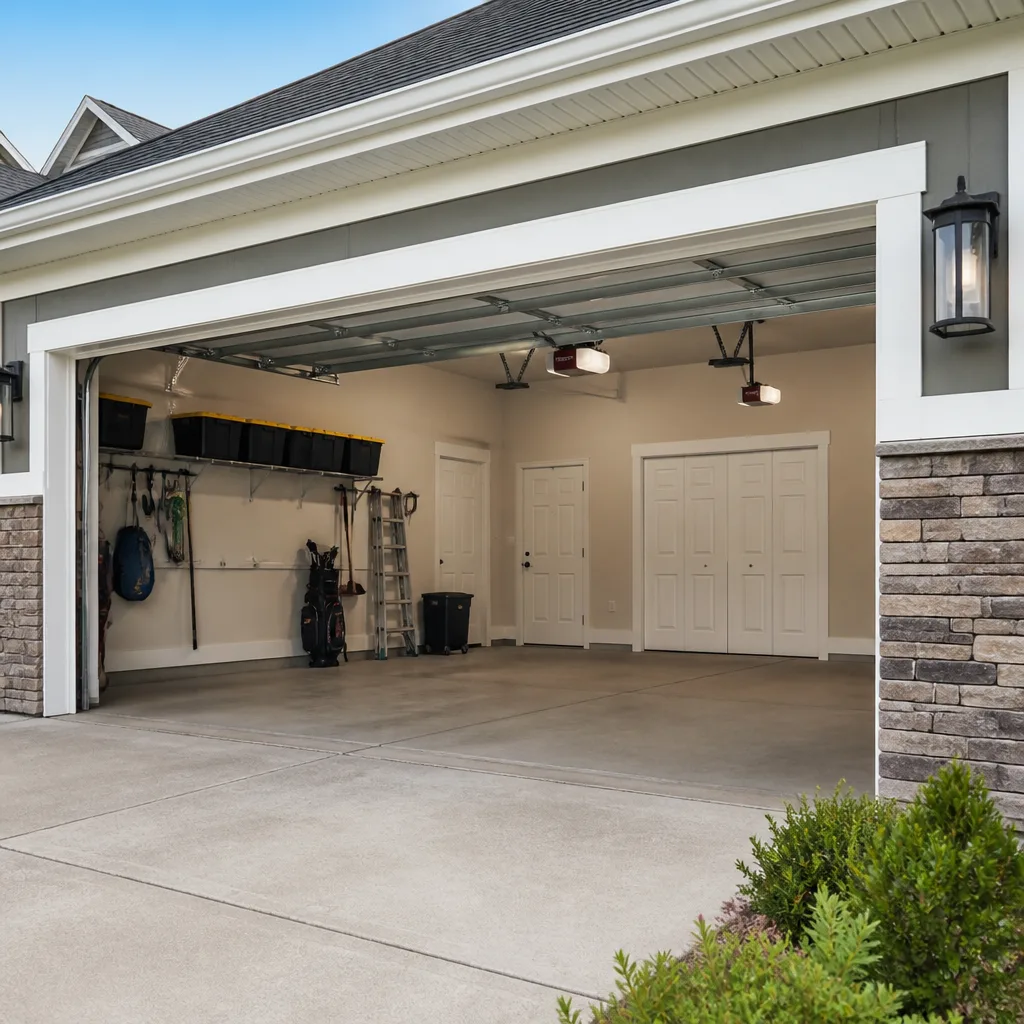 LiftMaster openers
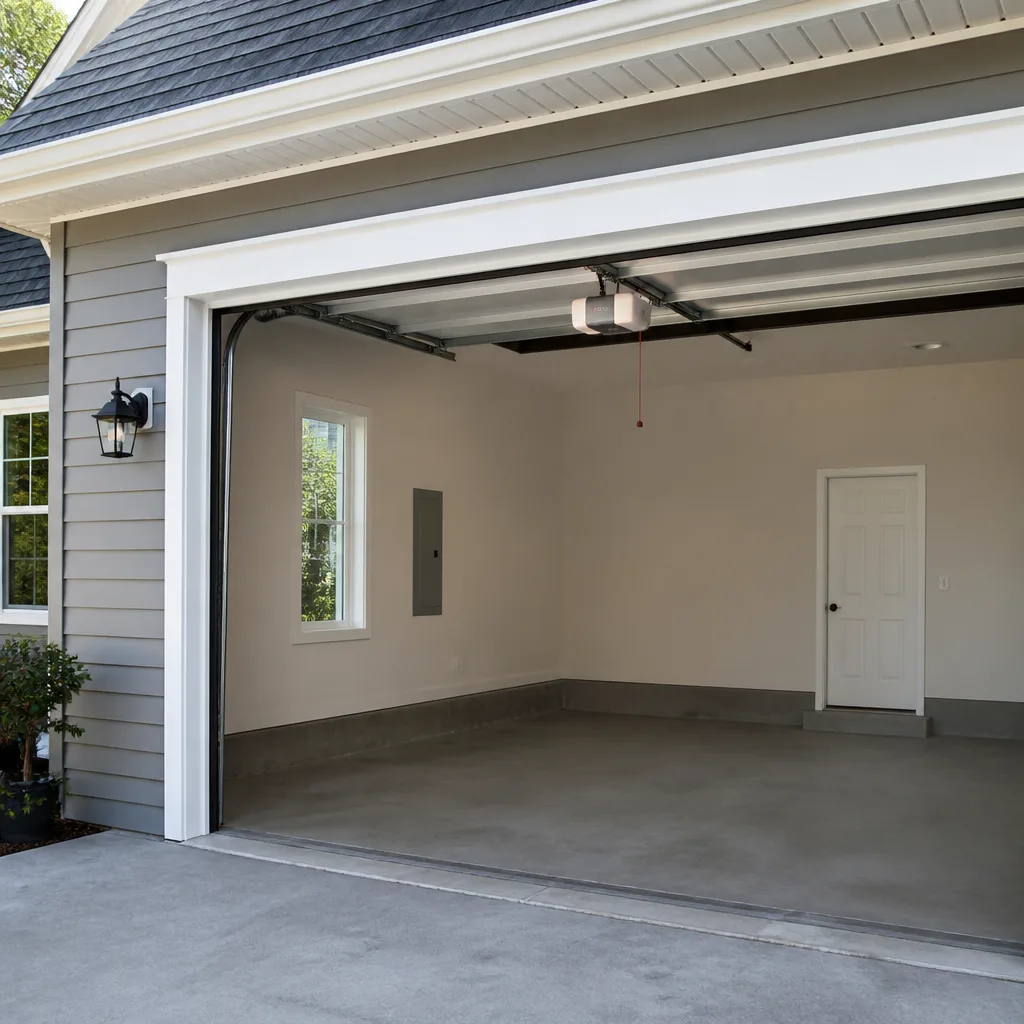 Chamberlain openers
Full 25-point door and opener safety check with every visit - springs, cables, rollers, tracks, and your LiftMaster or Chamberlain opener included
You get a price before we start. It does not change when the pro arrives.
Get your free estimateGarage Door Emergency Preparedness Guide for Poinciana Homes
The garage door emergency most Poinciana homeowners actually face isn’t storm damage. It’s a broken torsion spring on an ordinary weekday morning that leaves a car stranded inside the garage when someone has to be at work. Most preparedness advice skips right past that scenario and jumps to hurricane season, which means the everyday failure catches people with no plan at all. In this guide we separate the two categories of emergency properly: storm-related failures that come with a season’s warning, and mechanical failures that arrive without warning. You’ll learn how to release and operate a door by hand safely, what to check before storm season, how to secure a door that won’t close, and what to have ready when you call for help in Poinciana.
Quick Answer
Garage door emergency preparedness in Poinciana means having two separate plans: one for mechanical failures (a snapped spring, a dead opener, a door stuck open) and one for storm season. The everyday plan is a safe manual release and a phone number ready. The seasonal plan is a hardware check, a manual-operation test, and a backup battery check before hurricane season begins. Both take under an hour to set up, and both are far easier to put in place now than in the middle of a failure.
Styles & brands we work with
- Raised-panel steel
- Carriage house
- Modern flush
- Full-view glass
- LiftMaster openers
- Chamberlain openers
Table of Contents
- Why Poinciana Has Two Kinds of Garage Door Emergencies
- How to Release and Operate Your Door by Hand
- What Not to Do If a Spring Is Already Broken
- Pre-Hurricane Season Garage Door Checklist
- What to Do If the Door Comes Off the Track After a Storm
- How to Secure a Door That Won’t Close
- What to Have Ready When You Call for Emergency Service
- Key Takeaways
Why Poinciana Has Two Kinds of Garage Door Emergencies
Poinciana sits in a part of Central Florida where hurricane season runs from the start of June through the end of November. That’s half the year, and it’s the reason so much garage door advice here focuses on wind. But the mechanical failure category doesn’t care about the calendar. Springs fatigue, openers fail, and rollers jump their tracks on a perfectly calm Tuesday in February just as readily as in September. Treating the two as one problem is where most preparedness advice goes wrong.
The storm category is about the door as a building component. Wind pressure, debris impact, and the door’s ability to hold its opening closed. You have weeks to prepare for that, and the preparation is mostly checking hardware and testing systems.
The mechanical category is about the door as a machine. A torsion spring breaks, an opener’s drive gear strips, a cable slips. These failures strand vehicles, leave the house unsecured, or both, and they usually happen at the worst possible moment. You have no warning, so preparation means knowing the manual release procedure before you need it.
Poinciana’s housing stock reinforces the split. Much of the community is single-family homes where the garage is the primary entry point, not a secondary convenience. In neighborhoods across the community, from the older streets near the Poinciana Parkway corridor to newer construction on the east side, the garage door is the door the family actually uses. When it stops working, the front door becomes the only door, and for many households that’s a genuine disruption rather than a mild inconvenience.
So the guide ahead has two halves. The mechanical half is something every Poinciana homeowner should act on this week. The storm half is something to complete before June.
How to Release and Operate Your Door by Hand
Every automatic garage door has a manual release, and nearly every homeowner has never used it. That’s the first piece of preparedness most people skip, and it’s the one that matters most on a weekday morning when the car is trapped. The manual release disconnects the door from the opener so you can raise and lower it by hand.
The release is a cord with a handle, usually red, hanging from the opener’s trolley. On the most common opener models installed in Poinciana homes, including LiftMaster and Chamberlain units, the trolley sits on the rail above the door and the cord hangs down within reach when the door is closed. Genie and Craftsman openers use the same principle with slightly different trolley designs. Find yours now, while the door is working, and make sure every adult in the house knows where it is.
Here’s the safe sequence when the door is closed and you need to get a car out:
- Confirm the door is fully closed and no spring is broken. Look at the springs above the door. If either torsion spring has a visible gap, or an extension spring is stretched and hanging, stop here. Do not pull the release.
- Stand clear of the door’s path and pull the release cord straight down until the trolley disconnects. You’ll hear or feel a click.
- Lift the door slowly with both hands, using the bottom section’s lift handle. A properly balanced door should move with modest effort.
- Raise it fully open, then let it settle. Do not let go mid-travel.
- Move the car out, then lower the door gently by hand until it’s fully closed. A balanced door should close with light guidance, never a drop.
- Reconnect the trolley by pulling the release cord again or following the opener manufacturer’s reconnection steps, and test the opener with a short cycle.
If the door feels extremely heavy, rises unevenly, or won’t stay up when you let go, a spring or cable problem exists. Stop. Forcing a door in that condition can bring it down on you or bend the tracks. That’s the point to call for garage door repair rather than push through.
What Not to Do If a Spring Is Already Broken
If a torsion spring is snapped, the door is holding its full weight on the opener and the remaining spring, and the manual release will not save you. Pulling the release on a door with a broken spring lets that full weight come down under your control, which most people cannot manage safely. This is the single most important rule in this guide.
The springs above your garage door are the highest-tension mechanical component in a house. A torsion spring is wound to counterbalance the door’s weight, and when it breaks, the stored energy releases instantly. Replacing one requires winding bars, the right technique, and an understanding of how the cables are tensioned. This is not a homeowner task, and no amount of online video makes it one. The risk isn’t a damaged door. It’s serious injury.
What to do instead:
- Leave the door closed and leave the opener alone. Don’t run the opener to “see if it works.” It will strain the motor and can pull the door into a jammed position.
- Don’t try to lift or force the door up. With one spring gone, the door is far heavier than it looks.
- Keep kids and pets away from the door area. The cables and remaining spring are under tension.
- Call for spring service. Spring work is the specialty that separates trained technicians from generalist handymen. Our team handles high-tension spring systems as a core part of what we do, not as a sideline. More detail lives on our garage door spring repair page.
Here’s a cost fact worth knowing before you call. In the Poinciana market, a single torsion spring replacement typically runs in the range of $180 to $320 depending on the spring size and door weight, and most doors carry a matched pair that gets replaced together, so a pair usually lands around $360 to $640 installed. Prices are estimates; the written quote you get after a technician looks at the door is the final number, agreed before any work begins. Extension springs on older doors run somewhat less.
Pre-Hurricane Season Garage Door Checklist
Hurricane season gives you a warning that a broken spring never does, and the right time to act on it is before June. The checklist below takes about half an hour and covers the components most likely to fail under wind load. None of it requires tools beyond a screwdriver if the hardware is already there.
- Check the door’s bracing hardware. Look at the vertical and horizontal reinforcement on the inside of the door. On a wind-rated door or a door with a hurricane-rated label, there should be a steel or reinforced strut across the top sections. Confirm the fasteners holding it are tight and not corroded.
- Inspect the track brackets and hinges. Tug each bracket gently. A loose bracket needs tightening before wind pressure finds it. Look for rust at the hinge plates, which is common in Central Florida’s humid summer air.
- Test manual operation. Pull the release and raise and lower the door by hand, as described above. A door that drags or drops is out of balance, and an out-of-balance door will struggle against wind load at the worst time.
- Confirm backup battery function. If your opener has a battery backup, test it by unplugging the opener from the wall and running the door once. If the door doesn’t move, replace the battery. LiftMaster and Chamberlain units in particular commonly ship with backup batteries, and a dead one can go unnoticed for years.
- Clear the tracks. Debris, dirt, and hardened grease in the tracks cause doors to stall mid-travel. Wipe them clean and reapply a light lubricant made for garage door tracks. Never use household grease.
- Seal the gaps. A door that doesn’t sit flush leaves a wind gap at the bottom and lets water in during a storm. Check the bottom weather seal and replace it if it’s cracked.
- Look at the door panels. Check every panel for cracks, delamination, or loose hardware. A panel that’s already failing is the first one to give under a wind gust.
If your door isn’t rated for wind, or you’re not sure whether it is, it’s worth asking a technician to look at the door’s label and hardware. Wind rating isn’t a sticker you can add after the fact; it’s built into the door and its reinforcement.
What to Do If the Door Comes Off the Track After a Storm
A door that has jumped its track after a storm is in a genuinely dangerous state, more dangerous than it looks. The cables and springs are still under tension, and the door is no longer being held in its intended plane. Some temporary measures are safe. Others create real structural risk. The difference matters.
What’s safe to do while you wait for a technician:
- Keep everyone away from the door and clear the area beneath it. Move cars and anything valuable out from under it if you can do so without standing under the door.
- Leave the opener disconnected. Don’t try to run the opener to see if it will pull the door back into place. It will likely make things worse.
- If the door is partially open and the house is unsecured, secure the opening from the inside if possible. A brace against the door from the inside, or a temporary barricade across the opening, protects the house without loading the door’s hardware.
- Call for service immediately. This is a case where emergency service is genuinely warranted rather than convenient. See Poinciana Garage Door Repair Co for how we handle these calls.
What’s not safe, and this is the gap in most emergency guides:
- Don’t try to lift the door back onto the track by force. A door off its track can kick or twist, and the spring tension can release in unpredictable directions.
- Don’t cut, loosen, or remove the cables. Cable tension is what keeps the door from falling. Cutting a cable can let the door drop or whip.
- Don’t prop the door open with improvised framing that puts weight on a bent panel. It can crack the panel or push the track further out of alignment.
- Don’t run the opener in any mode, including manual. The trolley’s position on the rail matters, and forcing it can damage the opener’s limit switches.
If the door has damaged panels as well as jumped the track, panel replacement may be needed. Call (877) 471-4560. We answer 24/7. Fast dispatch from 7am to 7pm, Sunday through Friday.
How to Secure a Door That Won’t Close
A garage door that won’t close is the second-worst failure after a broken spring, because the house is open to the neighborhood all night. The most common causes are a misaligned safety sensor, a jammed track, a failed limit switch, or a control board fault on the opener. Here’s the sequence that handles all four without leaving the opener disabled. This is the gap in most emergency guides.
- Check the safety sensors first. The two small lenses at the bottom of the track, one on each side, should have steady lights. If one is flickering or dark, that’s the cause. Wipe both lenses with a dry cloth and check for obstructions: spider webs, grass clippings, a kid’s toy, or a broom handle leaning against the frame.
- Look at the sensor alignment. The sensors are aimed at each other. If one has been knocked, aim it back at its partner until both lights settle. A loose bracket can be gently hand-tightened.
- Pull the manual release only if the door is fully raised and a spring is intact. Lower the door by hand to full close, then reconnect the trolley. The door is now in the closed position, though the opener may still not work.
- Disconnect the opener temporarily and latch the door with its manual lock. Most garage doors have a slide lock or a manual latch on the inside. With the door closed and locked, the house is secured. The opener stays in working condition (it’s just disconnected), so there’s nothing to undo later.
- If the door won’t latch, use a temporary inside barricade. A bar across the inside of the door, resting in the door’s frame, keeps it from being opened from the street. Remove it before opening the door again.
The pattern to remember: a door that won’t close is usually a sensor or opener problem, not a door problem. Sensors are home-fixable. Openers and control boards are garage door opener repair work, so call a technician rather than dig into the opener electronics yourself. Electrical faults on an opener can burn out the board and turn a small fix into a larger one.
What to Have Ready When You Call for Emergency Service
The difference between a call that dispatches quickly and one that goes back and forth is the information you have ready. Poinciana Garage Door Repair Co handles emergency service as a core offering, and the faster we can picture the door and the failure, the more accurate the diagnosis is before the technician arrives. Here’s what helps.
- The door’s brand and model, and the opener’s brand and model. We service LiftMaster, Chamberlain, Genie, Clopay, Amarr, Wayne Dalton, Craftsman, and Raynor, and knowing the brand up front lets us arrive with the right diagnostic approach.
- What the door is doing. Stuck open? Stuck closed? Opens a foot then reverses? Grinding? A photo of the door and the springs sent to the number below tells us more than a paragraph of description.
- The age of the door if you know it. Springs have a working life that depends on cycles of use, and an older door with original springs is a common cause of weekday-morning failures.
- Whether the door is currently secured. If it’s open to the street, tell us; that changes the priority.
- Whether a car is trapped inside. This is the most common weekday emergency, and knowing it helps us flag the call.
- The address and any gate code or access instructions. Some Poinciana neighborhoods have gated or controlled access, and having the code ready speeds the arrival.
One caveat: don’t try to diagnose the opener or the springs yourself while you’re on the call. Describe what you see from a safe distance. Call (877) 471-4560. We answer 24/7. A call outside dispatch hours is booked into the next opening, Sunday through Friday, 7am to 7pm.
When technicians do arrive, our team has up to 9 years of experience across the brands above, so same-visit diagnosis and repair is often possible. If a spring or opener part has to be ordered, you’ll know that before any work starts, and the written estimate is agreed before we touch the door.
Key Takeaways
- Two plans, not one. Mechanical failures need a manual-release plan. Storm failures need a seasonal hardware check. Prepare for both.
- Find your manual release this week. Work out where the release cord is and practice operating the door by hand while it’s still working.
- A broken spring means don’t pull the release. Leave the door closed, leave the opener alone, and call for spring service.
- Before June, check the bracing, test manual operation, confirm the backup battery, and clear the tracks. That covers the components most likely to fail under wind load.
- A door off its track needs a technician. Don’t force it back on, and don’t cut cables.
- A door that won’t close is usually a sensor or opener issue. Disconnect, latch, barricade if needed, and call.
- Have the brand, the symptom, and access details ready. It speeds diagnosis before the technician arrives.
Common Mistakes to Avoid
- Pulling the manual release with a broken spring. With one spring gone, the door’s full weight comes down under your control, and most people can’t manage it. Check the springs before you pull the cord.
- Running the opener “to see if it works.” On a stuck or off-track door, this strains the motor, damages the limit switches, and can make a small repair into a larger one. If the door is jammed or off its track, leave the opener alone.
- Testing manual operation for the first time during a hurricane warning. Poinciana’s storm season gives you months of warning, and the right time to test the manual release is in calm weather, not while a storm is approaching.
- Cutting or loosening cables to “free” a stuck door. Cables are under tension and hold the door up. Cutting one can let the door fall, and it’s a genuine injury risk.
- Adding wind-rated hardware to a door that isn’t rated for it. Wind rating is a door-and-hardware system, and adding struts to an unrated door doesn’t make it rated. Get a professional inspection if you’re not sure what your door’s rating is.
- Ignoring a sensor that flickers. A flickering sensor is an intermittent failure that will stop the door at random, often at night, often while you’re backing out. Fix it as soon as you notice.
- Leaving the manual release cord hanging too high or too short. Some installers shorten the cord or affix it so it doesn’t reach easily. In Poinciana’s heat, a stiff or short cord is a real problem on a day when you need it. Check it now while it’s easy.
See the difference
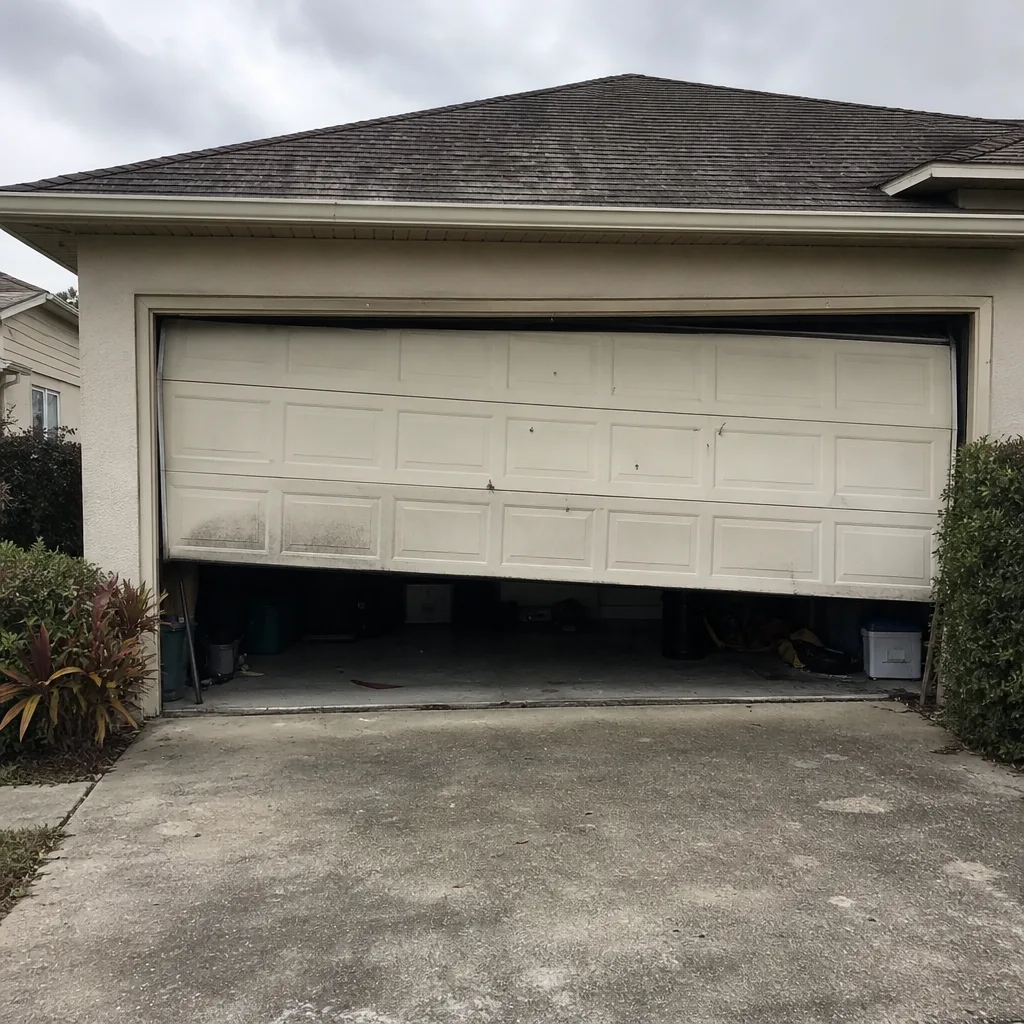 Before
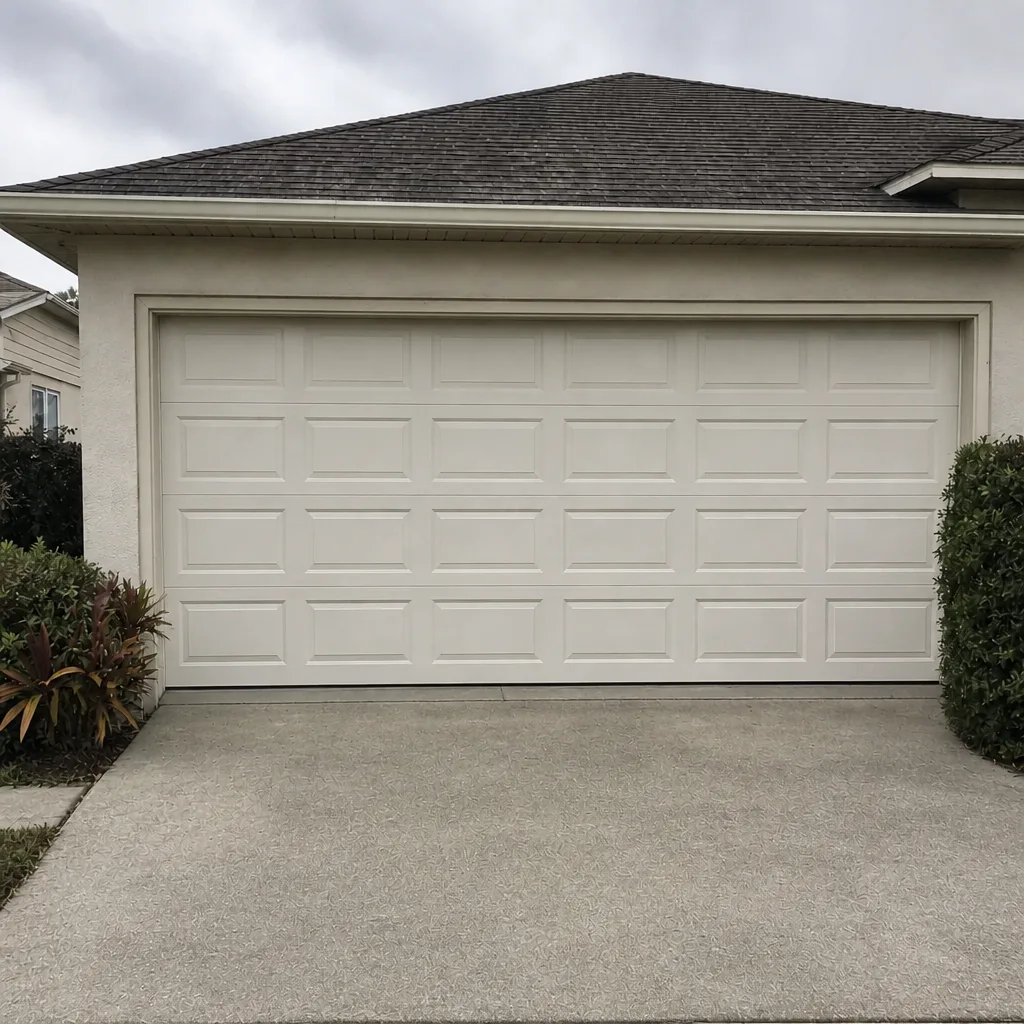 After
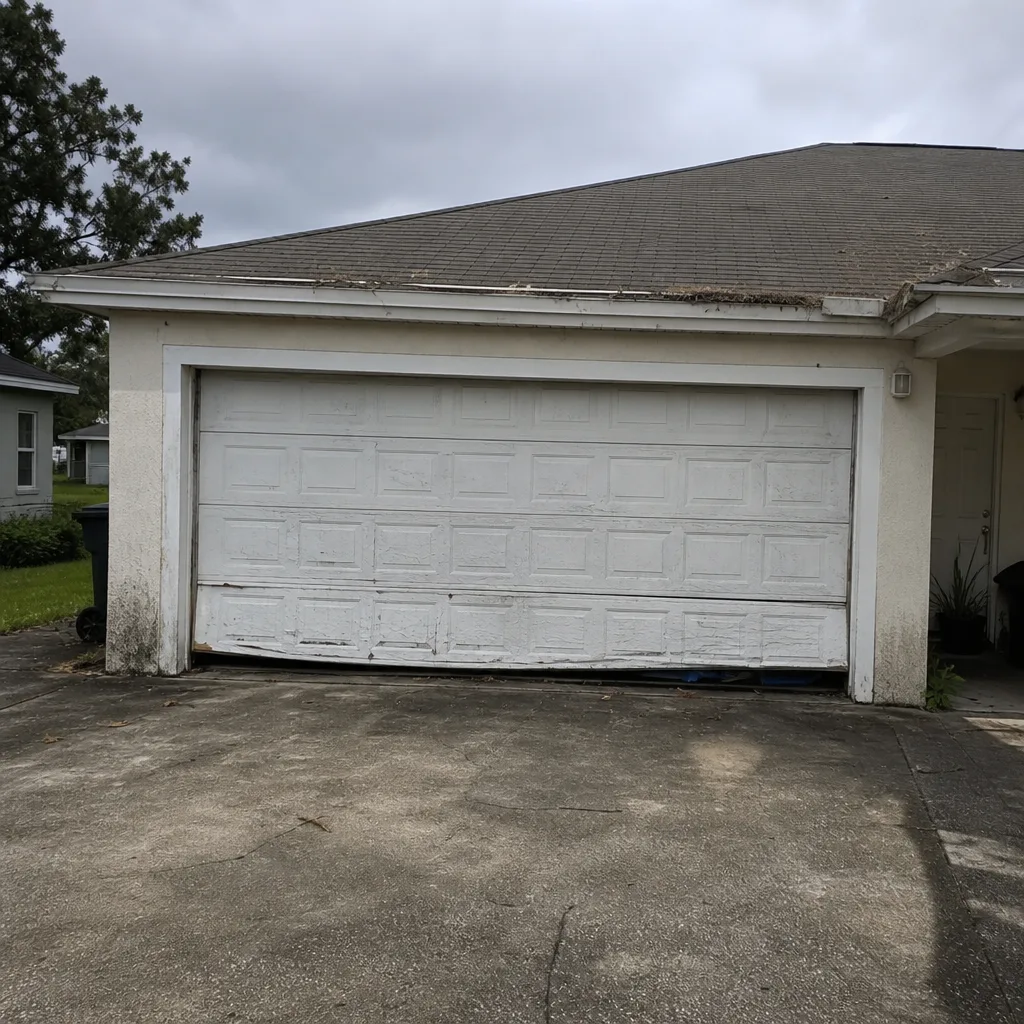 Before
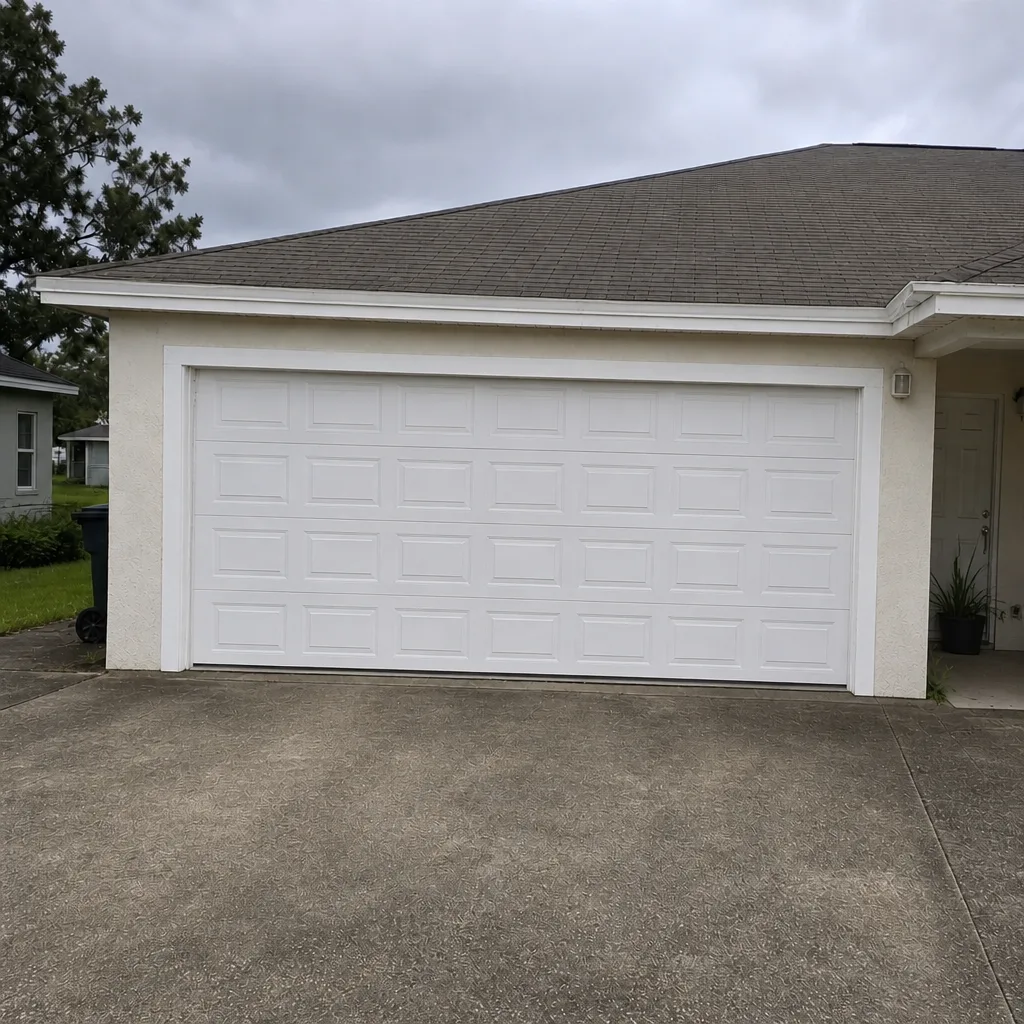 After
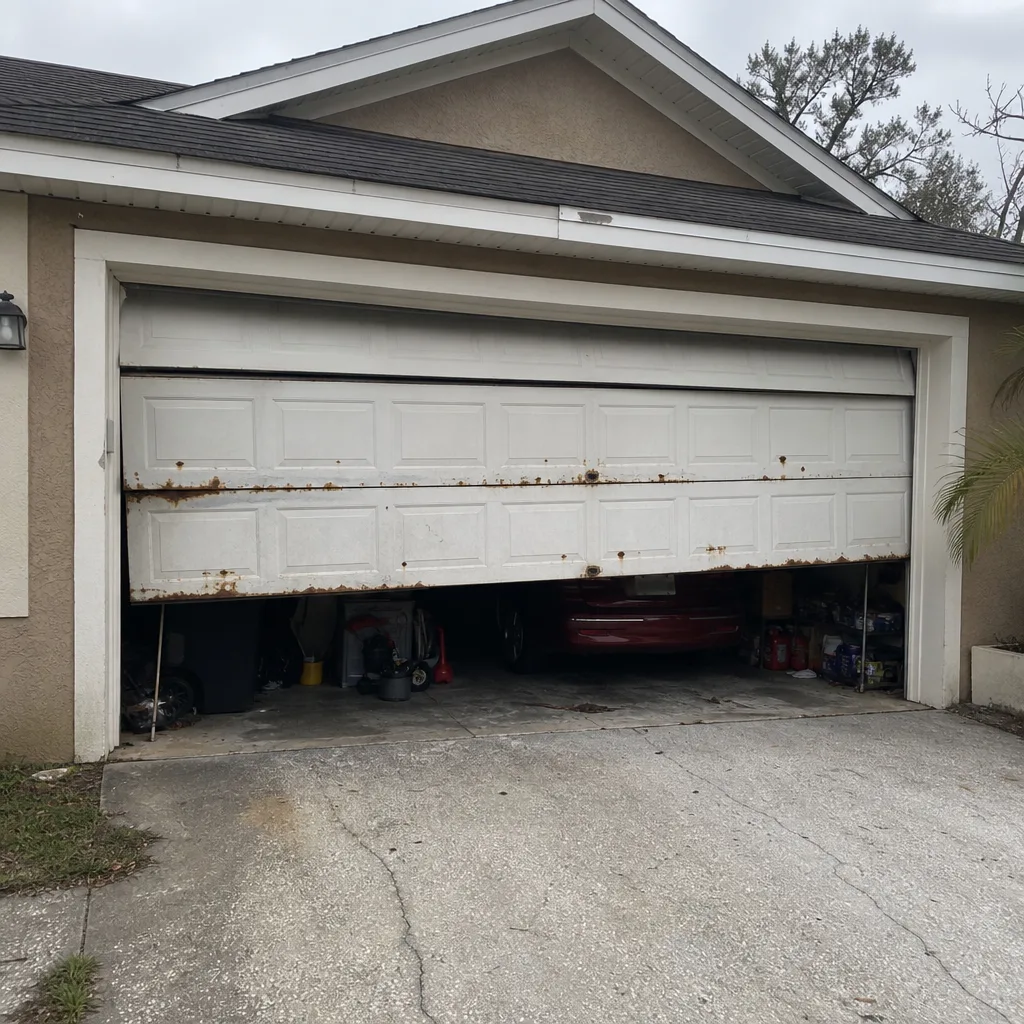 Before
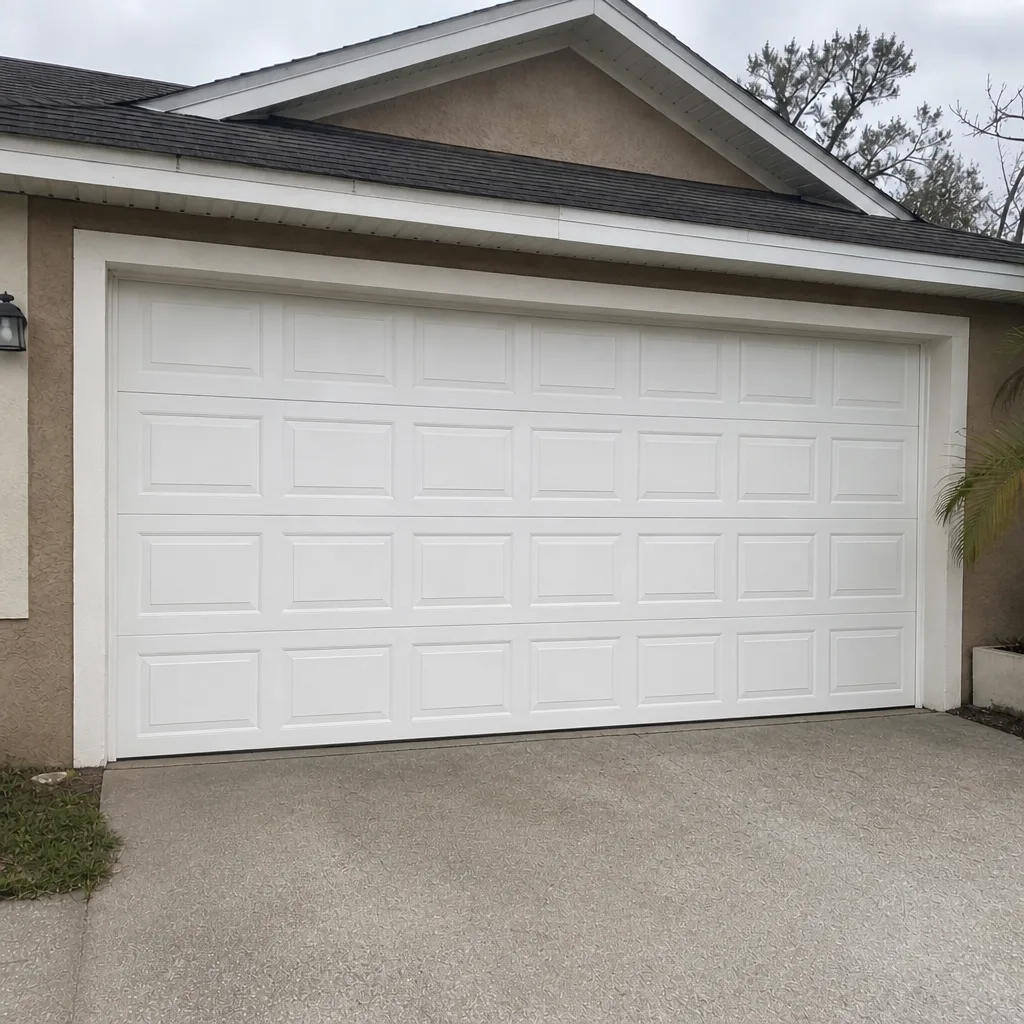 After
When to Call a Professional
Call a professional for anything that involves spring tension, cable tension, opener electronics, or a door off its track. Those are the four categories where homeowner intervention is genuinely dangerous. We also recommend a professional call when a door won’t close and the sensor fix doesn’t solve it, when a door drags or drops noticeably during manual operation, and when you’re unsure whether your door is wind-rated before hurricane season. Poinciana Garage Door Repair Co offers free estimates in Poinciana – call (877) 471-4560. We handle everything from a snapped spring to a full new door installation, and the local professional is licensed and insured as their state requires. The price is quoted and agreed before any work starts, and the written estimate sets the final price.
Frequently Asked Questions
A single torsion spring replacement in Poinciana typically runs around $180 to $320 installed, and since most doors use a matched pair that’s replaced together, a pair usually lands around $360 to $640. Extension springs on older doors tend to run less. Call (877) 471-4560 for an exact quote – estimates are free.
In most cases yes, and a car trapped by a broken spring or failed opener is the most common weekday emergency we handle. Call (877) 471-4560. We answer 24/7. Fast dispatch from 7am to 7pm, Sunday through Friday. A call outside dispatch hours is booked into the next opening.
No. The written estimate is agreed before any work starts, and that number is the price. If the technician finds an additional issue once the door is open, they’ll explain it and quote it separately before touching it. Nothing gets added without your agreement first.
Yes, provided the springs are intact and the door is balanced. Pull the manual release cord, lift the door slowly with both hands, and move the car out. If the door feels very heavy, rises unevenly, or won’t stay open when you let go, that indicates a spring or cable problem. Stop and call for service rather than force it.
The local professionals we connect you with are licensed and insured as their state requires. Our team services all major brands, including LiftMaster, Chamberlain, Genie, Clopay, Amarr, Wayne Dalton, Craftsman, and Raynor, and our technicians have up to 9 years of experience. Call (877) 471-4560 for a free estimate.
Check the safety sensors first: wipe the lenses and look for obstructions, since a misaligned or dirty sensor is the most common cause. If that doesn’t solve it, disconnect the opener, lower the door by hand, latch it with the manual slide lock, and call a technician. If the door won’t latch, a temporary barricade across the inside of the door frame will secure the opening. Call (877) 471-4560. We answer 24/7. Fast dispatch from 7am to 7pm, Sunday through Friday.
The Bottom Line
Garage door emergencies in Poinciana are two problems, not one. Mechanical failures arrive without warning and are answered by knowing your manual release and never pulling it with a broken spring. Storm failures come with a season’s warning and are answered by a hardware check, a manual operation test, and a backup battery test before June. Both take under an hour to prepare for and both are far easier now than in the middle of a failure. Find your release cord this week. Run the storm checklist before the calendar turns. And save the number below.
Contact Us
Poinciana Garage Door Repair Co handles spring repair, opener repair, panel replacement, full door installation, and emergency service on every major brand. When the door won’t move, we move fast. Call (877) 471-4560 for a free estimate. We answer 24/7. Fast dispatch from 7am to 7pm, Sunday through Friday. The price is quoted and agreed before any work starts, and the written estimate sets the final price.
Written by the team at Poinciana Garage Door Repair Co.